Agentic AI Security: What Happens When Your AI Agent Has Its Own Credentials?

An assistant that drafts an email is a tool. An assistant that reads a ticket queue, queries a database, updates a record and notifies a customer without anyone approving each step is something else: a non-human identity acting inside your estate with permissions of its own. That shift is happening quietly in most enterprises, usually inside an automation project rather than a security one, and the ai security guardrails that should govern it are rarely in place before the agent is. This article covers what changes when an agent holds credentials, why classic identity controls partially fail, and the design pattern that keeps agentic automation useful without creating standing privilege nobody can account for. Our note on why identity has become the security perimeter sets the wider context.
Key Takeaways
- An AI agent is a non-human identity with an unusual property: its next action is decided by a model reading untrusted input, so its behaviour is not fully predictable from its configuration.
- Scope the credential, not the prompt. Instruction-level restrictions are advisory; permission boundaries and approval gates are the only controls that hold when the model is manipulated.
- Every agent needs a named human owner, a defined lifetime and a tested revocation path, because agents outlive the projects that created them far more reliably than service accounts do.
What Actually Changes When an Agent Holds Credentials
Enterprises have run non-human identities for decades, and the ai security guardrails around them are well understood. Service accounts, integration users and machine credentials are familiar, and the controls around them are well understood: least privilege, rotation, a named owner and monitoring. An AI agent inherits all of that and adds one property that breaks the model.
A conventional service account does the same thing every time. Its behaviour is fully described by its code, so the permissions it needs can be enumerated in advance and anything outside that set is an anomaly. An agent's next action is chosen by a model at runtime, based on input that frequently originates outside the organisation, which means its behaviour cannot be fully enumerated from its configuration.
That single difference has three consequences. Permission scoping has to be tighter, because you cannot rely on the agent only attempting what it was designed for. Monitoring has to record intent as well as action, because the interesting question becomes why the agent did something rather than what it did. And revocation has to be immediate and tested, because an agent behaving unexpectedly cannot be reasoned with mid-task.
The second change is chaining. Agents increasingly call other agents and external tools, and each hop can carry the original credential forward. A permission granted to a customer-service agent may end up exercised by a summarisation tool three steps away that nobody reviewed, which is a delegation path the classic service account model never had to describe.
Neither of these makes agentic automation unsafe. They make it a design problem that has to be solved before deployment rather than after the first incident.
The Failure Modes That Actually Occur
The most common failure of ai security guardrails is prompt injection reaching a privileged action. An agent processes content it did not author, a support ticket, a document, a web page, and that content contains instructions the model follows. If the agent's credential can perform a consequential action, injected instructions can trigger it. The model is not compromised in any technical sense; it is doing exactly what it was built to do with input it cannot distinguish from a legitimate request.
The second is scope creep through convenience. An agent is granted broad read access during development because narrowing it slows testing, and the narrowing never happens. Six months later the agent holds a standing credential across systems it touches in less than one percent of its tasks, and nobody can safely remove permissions because nobody knows which ones are load-bearing.
The third is orphaned agents. The project that created the agent finishes, the team disperses, and the agent continues to run with valid credentials and no owner. Service accounts have this problem too, but agents are worse because they are frequently created inside business teams rather than by platform engineering and never enter the identity register at all.
The fourth is untraceable action. When something goes wrong, the log shows an API call from a service credential and nothing about the conversation that produced it. Without the prompt, the retrieved context and the model's stated reasoning recorded alongside the action, an investigation cannot establish whether the agent was manipulated or simply wrong.
Guardrails That Hold Under Manipulation
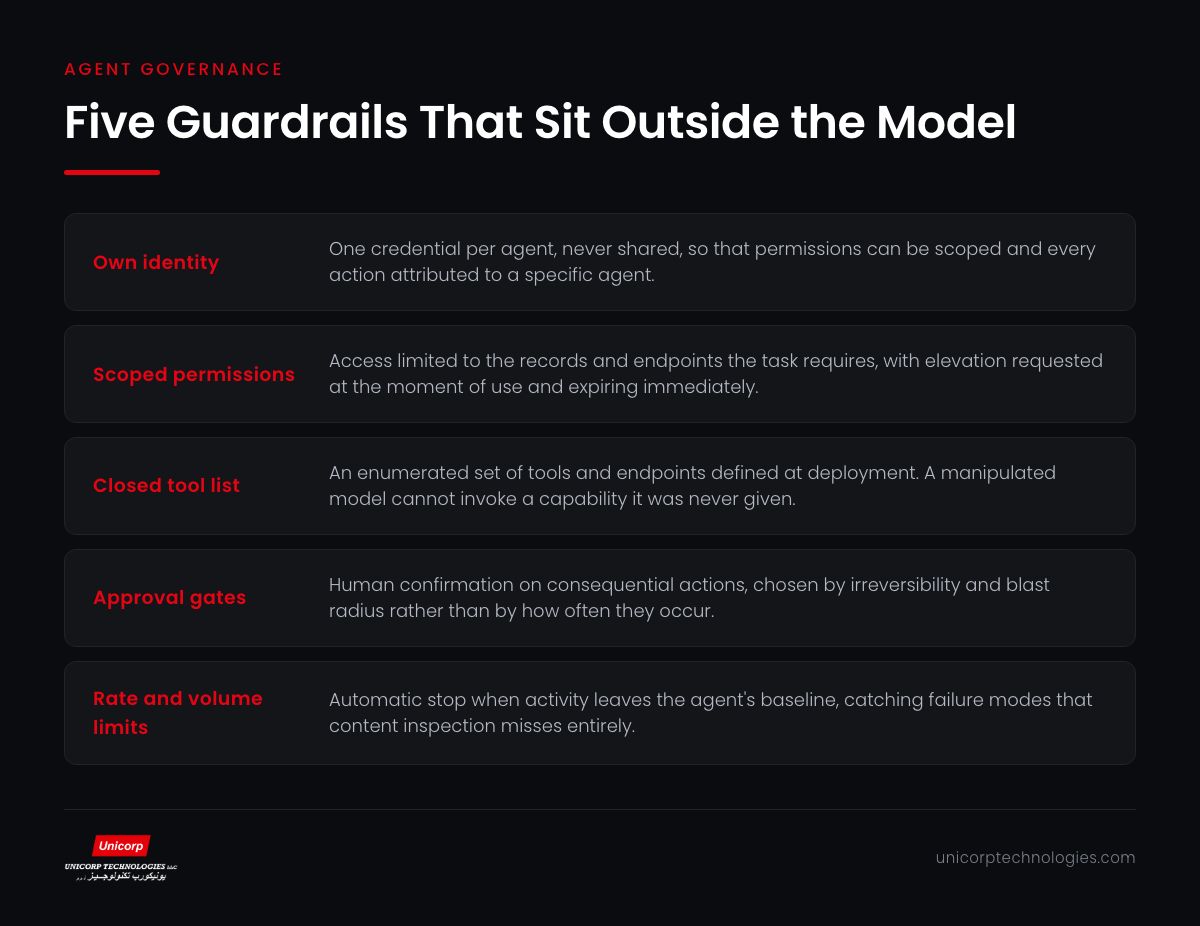
The organising principle is that ai security guardrails must sit outside the model. Anything expressed as an instruction in a system prompt is advisory, because the same channel that carries your instruction carries the attacker's. Controls that hold are the ones the model cannot argue with.
Start with permission scoping at the credential rather than the prompt. Each agent gets its own identity, not a shared one, with permissions scoped to the specific records, tables or endpoints its task requires and nothing adjacent. Where a task needs elevated access occasionally, that access should be requested at the moment of use and expire immediately afterwards rather than being held permanently. The principles in what modern PAM strategies require in 2026 apply directly here.
Add an approval gate on consequential actions. Define which operations require a human to confirm before execution, based on irreversibility and blast radius rather than on how often they occur. Sending an external email, moving money, deleting records and changing permissions belong in that set for almost every organisation.
Published catalogues of adversarial machine learning techniques, notably MITRE ATLAS, and the OWASP Top 10 for large language model applications, are the two references worth mapping your control set against. Constrain the tool surface explicitly. An agent should be able to call only an enumerated list of tools and endpoints, defined at deployment. This is the control that limits the damage from a successful injection, because even a fully manipulated model cannot invoke a capability it was never given.
Finally, rate limit and budget. An agent that normally performs a handful of operations per hour should be stopped automatically when it attempts hundreds, regardless of whether the requests look individually legitimate. Volume anomalies catch several failure modes that content inspection misses entirely.
Identity, Ownership and Lifecycle
Durable ai security guardrails start with a registry entry carrying the same fields you would demand of any privileged account: a unique identity, a named human owner, the business justification, the permission set, the creation date and a review date. Agents without registry entries are the ones that become orphaned, and the registry is what makes the quarterly review possible at all.
Ownership should sit with a person rather than a team mailbox, and it should transfer explicitly when that person moves. Where an agent is created by a business function, the owner is that function's lead, not the platform team who provisioned it. This matters because the owner is the person who will be asked whether the agent should still exist.
Lifetime should be bounded by default. Give every agent credential an expiry, and require an active renewal that revisits the permission set. Renewal is where scope creep gets reversed, and an agent whose owner cannot justify its permissions at renewal is an agent that should be narrowed or retired.
Revocation must be tested rather than assumed. Confirm that disabling the agent's identity actually halts it, that in-flight tasks terminate safely, and that no secondary credential or cached token allows it to continue. Run this test at deployment and repeat it annually. Our note on measuring identity risk across an organisation covers how to quantify the exposure these accounts represent.
Include agents in access reviews explicitly. Most review processes enumerate human accounts and skip non-human ones, which is how a broad standing credential survives four consecutive certification cycles without anyone looking at it.
Logging Intent, Not Just Action
Conventional application logging records what happened. For agents that is insufficient, because the question during an investigation is why. The record needs to link the action to the input that produced it, which means storing the prompt or trigger, the context retrieved, the tools invoked with their parameters, and the model's stated reasoning where the platform exposes it.
This creates its own data protection consideration, since prompts and retrieved context frequently contain personal or confidential information. Apply the same classification, retention and access controls to agent logs as to the underlying data, and decide the retention period deliberately rather than defaulting to the platform maximum.
Correlation is what makes the logs useful. The agent's action log and the target system's audit log need a shared identifier so that a suspicious database change can be traced back to the conversation that caused it. Without that join, you have two logs and no investigation.
Alerting should focus on the transitions that matter: an agent invoking a tool it has not used before, accessing a record set outside its normal pattern, or generating a burst of activity outside its baseline. These are simple detections and they catch the realistic failure modes.
Set the retention period against your incident response expectations rather than storage cost. Agent incidents are frequently discovered weeks later through a downstream effect, and logs that expired after fourteen days make the investigation impossible.
A Deployment Checklist and Where to Start
Before any agent reaches production, confirm eight things. It has its own identity rather than a shared one. Its permissions are scoped to the specific task. Its tool list is enumerated and closed. Consequential actions require human approval. Rate and volume limits are configured. A named human owner is recorded with a review date. Intent-level logging is enabled and correlated with target system logs. And revocation has been tested end to end.
For an organisation starting from nothing, the first move is discovery rather than policy. Find the agents that already exist, which usually means asking business teams what automation they have built and reviewing which credentials are being used by non-human callers. Most enterprises find more than they expected, and several with permissions nobody would approve today.
The second move is to bring those agents into the identity register and assign owners. This is administrative work with no visible output, and it is the step that makes everything afterwards possible. Skipping it produces a policy that applies to agents you know about and no others.
Third, apply the checklist to the highest-risk agent first, learn what breaks, and turn that into the standard pattern for the rest. Attempting to apply full ai security guardrails across every agent simultaneously usually stalls, because each one needs a conversation with its owner about which permissions are genuinely required. Aligning the pattern with your existing zero trust access model avoids building a parallel set of controls.
If you are introducing agentic automation and want the guardrails designed before deployment rather than retrofitted afterwards, our identity and AI security team can review the architecture with you.