Building a Cloud Governance Framework

Cloud governance has a reputation problem inside engineering teams, and it is largely deserved. In most enterprises it arrives as a document, describes standards nobody can verify, and adds an approval step that delays delivery without preventing a single misconfiguration. Framed that way it is bureaucracy. Framed correctly it is the opposite: a set of guardrails encoded in the platform so that the compliant path is the fastest one and teams stop needing permission for routine work. Good cloud consulting providers make that distinction the centre of the engagement. This article covers the six components a workable framework needs, how to enforce each through automation rather than review, and how to introduce it into an estate that is already running. Our note on a data-driven guide to cloud migration for UAE enterprises covers the planning stage.
Key Takeaways
- Governance that lives in documents is advisory. Governance encoded in landing zones, policy engines and pipelines is enforced, and only the second kind changes outcomes.
- Six components carry the framework: account structure, identity, network, data, cost and change. Each needs a named owner and an automated control.
- Introduce it to new workloads first and bring the existing estate in behind them, or the programme stalls in remediation before it delivers anything.
What a Framework Is Actually For
The purpose of cloud governance is to let teams move quickly without each of them independently deciding how encryption, network exposure, identity and logging should work. When those decisions are made once and encoded into the platform, an engineer provisioning a service gets a compliant configuration by default and never has to think about it.
That is the opposite of what most frameworks deliver. A standards document that engineers must read, interpret and apply correctly puts the decision back on every individual, produces variation, and creates the review step everyone resents. The document is not wrong; it is simply in the wrong place.
The practical test is straightforward. If a team can provision a non-compliant resource and only discover it during a review weeks later, your governance is advisory. If the platform refuses to create it and explains why, your governance is enforced. Everything else in the framework follows from moving controls across that line.
This is also what separates useful cloud consulting providers from ones selling documentation. The deliverable that matters is a landing zone, a policy set and a pipeline, not a folder of standards that a subsequent engagement will be needed to implement.
Recognised control catalogues such as the Cloud Controls Matrix provide the content. The framework's job is deciding where each control is enforced and who owns it.
Component One and Two: Account Structure and Identity
Most cloud consulting providers start here, because account and subscription structure is the foundation because it determines what every other control can express. Environments should be separated at the account level rather than by tags or naming conventions, so that a production boundary is a hard boundary the platform enforces rather than a convention people can breach accidentally.
Organise accounts by workload and environment, with shared services in their own account and a dedicated account for logging that no workload administrator can write to. This last detail matters more than it appears: log integrity depends on the logs being outside the reach of whoever might want to alter them.
Identity is the second component and the one that determines blast radius. Federate to a central identity provider rather than creating local users in each cloud, use short-lived credentials for both people and automation, and eliminate long-lived access keys, which appear in every assessment and are among the most commonly exploited findings.
Permissions should be issued through roles attached to groups, with elevation requested at the moment of use and expiring immediately afterwards. Standing administrative access in a cloud account is the single largest avoidable risk in most estates, and removing it is usually a matter of process rather than technology.
Both components should be established before any significant workload lands. Retrofitting account structure onto a running estate is possible and considerably more expensive than getting it right at the start.
Component Three and Four: Network and Data
Network governance in the cloud is less about perimeter and more about default posture. New resources should be private by default, with public exposure requiring an explicit, reviewable decision rather than being the path of least resistance. Most cloud data exposure incidents trace to a default that was permissive and a team that did not change it.
Connectivity between accounts and back to on-premises should follow a defined pattern rather than being solved individually by each project. Where every team builds its own connectivity, the estate accumulates paths nobody has mapped, and lateral movement becomes possible in ways no diagram predicts.
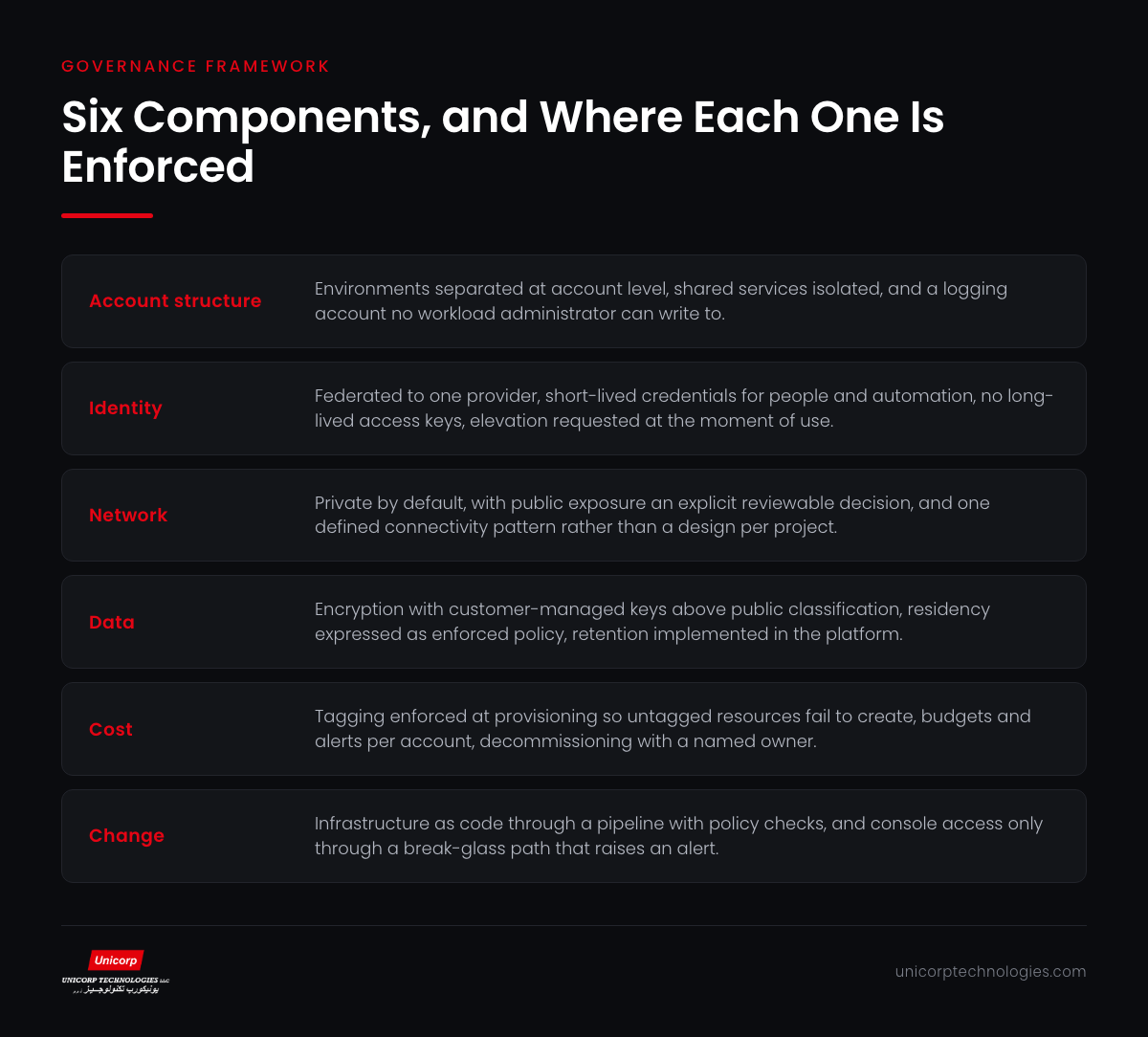
Data governance covers classification, encryption, residency and retention. Encryption at rest with customer-managed keys should be the default for anything above public classification, and residency requirements need to be expressed as policy that the platform enforces rather than as a guideline that a project can overlook during a deadline.
Data residency deserves particular attention for UAE entities, because the requirement usually extends beyond primary data to backups, logs and telemetry. A monitoring service defaulting to a region outside the country is one of the most common findings in a first governance review, and it is far easier to prevent at landing zone level than to unwind afterwards.
Retention is the component most often left out and the one auditors ask about. Both minimum retention for records and maximum retention for personal data need to be implemented in the platform, because a retention schedule that exists only in a policy document is a schedule nobody is following.
Component Five and Six: Cost and Change
Cost governance belongs in the framework rather than in a separate finance process, because the controls are the same controls. Mandatory tagging enforced at provisioning, budgets with alerts per account, and a decommissioning process with an owner are all governance mechanisms that happen to produce financial outcomes.
The tagging requirement should be enforced rather than requested. A resource created without an owner tag should fail to provision, which sounds severe and is the only approach that produces a tagged estate. Requesting tags produces roughly half an estate tagged and a permanent argument about the rest.
Change governance is the sixth component and the one that ties the others together. Infrastructure should be defined as code, reviewed through the same process as application code, and applied through a pipeline with policy checks. Manual changes in the console should be possible only in a defined break-glass process that generates an alert.
That break-glass path needs to exist, because prohibiting console access entirely produces workarounds during incidents. What matters is that using it is visible, time-bound and reviewed afterwards, so that emergency access does not quietly become normal access.
Our note on secure and efficient application migration to cloud providers covers how these components apply during a migration.
Enforcing Through the Platform, Not the Meeting
Each component needs an enforcement mechanism, and experienced cloud consulting providers will usually propose one of four. Landing zone configuration sets the baseline for every new account. Policy engines evaluate resources continuously and can prevent or remediate. Pipeline checks validate infrastructure definitions before provisioning. And detective controls report drift after the fact.
Prefer prevention where the rule is unambiguous and detection where judgement is involved. A storage bucket that must be encrypted is unambiguous and should be prevented. A network path that may be legitimate depending on context should be detected and reviewed, because a preventive control on an ambiguous rule generates exceptions faster than anyone can process them.
Every enforced rule needs a documented exception route with an owner and an expiry. Rules with no exception route get bypassed through other means, usually by provisioning outside the governed accounts, which is the worst possible outcome.
Measure the framework on prevention rate rather than on compliance percentage. How many non-compliant configurations were blocked at provisioning versus found later by a detective control. A healthy programme moves steadily toward the former, and that trend is the evidence that governance is reducing work rather than adding it.
Publish the rules where engineers work, in the pipeline output and the error messages, rather than in a document repository. A policy failure that explains what is wrong and how to fix it teaches the standard far more effectively than any training session.
Phasing It Into a Running Estate
Provider well-architected guidance, such as the Azure Well-Architected Framework, is worth mapping the framework against so that the rules you enforce align with the platform's own recommendations rather than diverging from them.
Apply the framework to new workloads first. This gives you a clean reference implementation, it does not disrupt anything currently running, and it lets teams see the model working before they are asked to change what they already have.
Then bring the existing estate in by criticality, starting with the accounts holding the most sensitive data rather than with the ones that are easiest to remediate. Easy-first sequencing produces good compliance numbers and leaves the real exposure untouched.
Expect to grant exceptions and record every one with an owner and a date. Legacy workloads that cannot meet the standard are a legitimate reality; unrecorded exceptions are not. The exception register becomes the roadmap for the following year.
Review the framework itself annually. Cloud provider capabilities change, and rules written three years ago frequently prohibit a service that is now the better answer, or mandate a mechanism the platform has superseded. A framework nobody revisits becomes an obstacle rather than a guardrail.
If you want help designing or reviewing a framework against your estate, our cloud team can work through the six components with you. You can also see how our infrastructure and data platform practice implements landing zones and policy sets, and our note on seamless cloud transformation in the UAE.
Frequently Asked Questions
How do I tell whether our governance is real?

Why separate environments at account level?
Where should logs be written?
How should permissions be issued?
Should tagging be enforced or requested?
When should a rule prevent rather than detect?
Do we need a break-glass path for console access?
Where should the framework be applied first?
How often should the framework be reviewed?