Cloud Cost Optimization Without Compromising Security

Every cloud cost programme eventually reaches the security line items, and that is where the conversation usually goes wrong. Log retention, non-production environments, cross-region replication and standby capacity are all visible, all expensive, and all easy to reduce without anyone noticing the effect until an incident. Meanwhile the genuinely wasteful spend, idle resources and over-provisioned instances, sits in a different part of the bill and attracts less attention because it belongs to nobody. Cloud cost optimization done well removes the second category and leaves the first intact, which requires the security team in the room rather than consulted afterwards. This article sets out how to run that programme. Our note on secure and efficient application migration to cloud providers covers the migration decisions that create most of the spend.
Key Takeaways
- Roughly three quarters of realisable savings sit in idle resources, over-provisioning and commitment coverage, none of which affects security posture at all.
- Four reductions look attractive and quietly weaken the estate: log retention, non-production parity, replication scope and standby capacity.
- Give every environment a cost owner and a security owner who sign off together, or the cheapest change will always be the one that removes a control nobody defended.
Where the Safe Savings Actually Are
The first and largest cloud cost optimization category is resources nobody is using. Unattached storage volumes, idle load balancers, orphaned snapshots, development environments left running over weekends and instances belonging to projects that finished. In most enterprise estates this alone accounts for a substantial share of the bill, and removing it carries no security consequence whatsoever.
The second is over-provisioning. Instances sized for a launch that never reached its projected load, databases running at a fraction of provisioned capacity, and storage tiers chosen for performance requirements that no longer apply. Rightsizing against observed utilisation is straightforward, reversible and equally security-neutral.
The third is commitment coverage. Workloads that will certainly run for the next year are frequently paid for at on-demand rates because nobody owns the commitment decision. Moving predictable baseline capacity onto committed pricing is a financial exercise with no technical change at all.
Where an estate spans more than one provider, the equivalent guidance from each platform is worth reading side by side; the Azure Well-Architected Framework uses the same pillar structure, which makes a common review checklist practical across clouds.
The fourth is data transfer and architecture inefficiency: traffic crossing regions unnecessarily, services chatting across availability zones when they could be co-located, and data egressing to the internet when it could stay inside the provider network. These need engineering effort but no security trade-off.
Together these four typically cover most of what a cost programme can realistically achieve. Structured guidance such as the AWS Well-Architected Framework treats cost and security as separate pillars precisely so that decisions in one can be tested against the other.
Four Cuts That Quietly Cost You Later
The first is log retention. Storage costs grow with retention, and reducing ninety days to thirty produces an immediate visible saving. The consequence appears months later, when an intrusion discovered through a downstream effect cannot be scoped because the evidence has aged out. Investigations that cannot establish what was accessed force conservative notification decisions that cost far more than the storage did.
The second is non-production parity. Development and test environments are obvious targets, and reducing their security configuration to save money is common. The result is that vulnerabilities are found in production rather than in test, and that non-production environments holding copies of real data become the softest route into the estate.
The third is replication and backup scope. Narrowing what is replicated, or which copies are kept immutable, reduces cost and reduces recoverability by exactly the same amount. This decision belongs with whoever owns the recovery objective, not with whoever owns the bill.
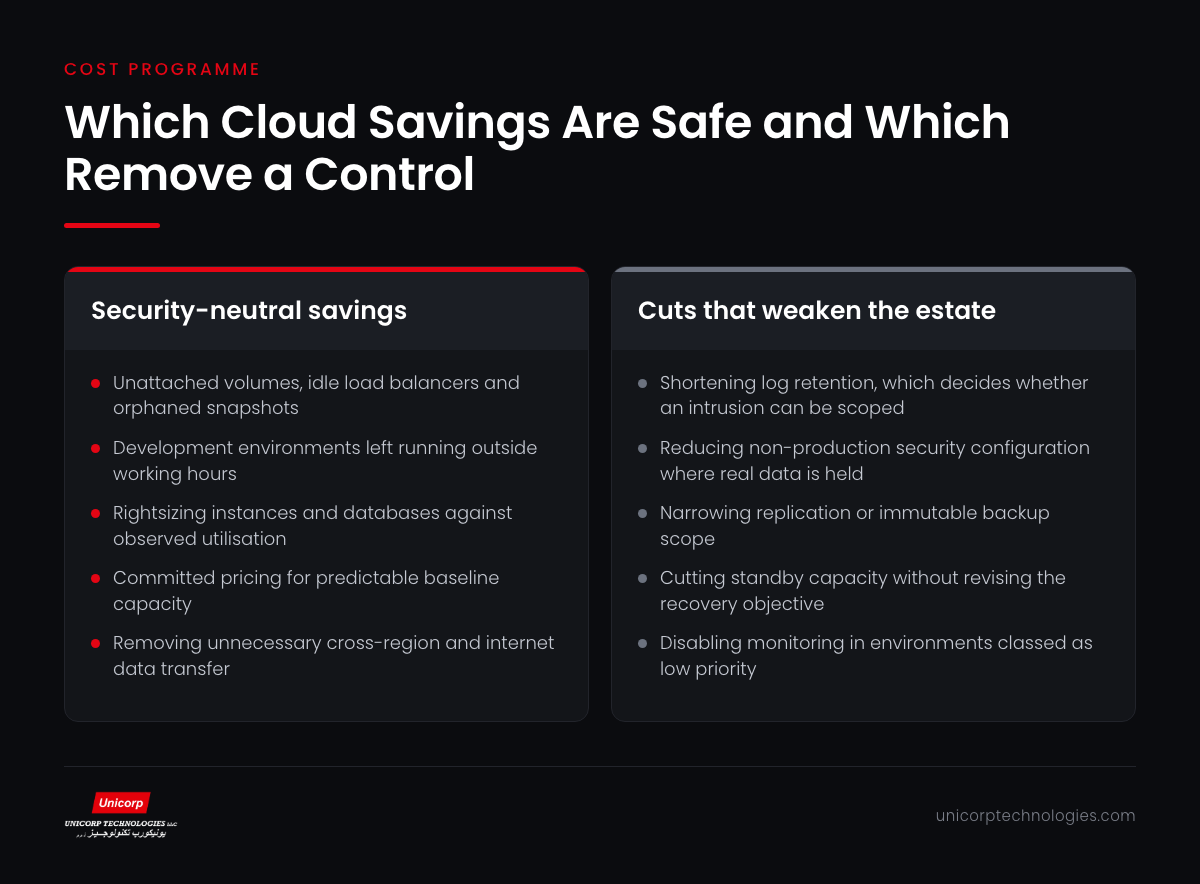
The fourth is standby capacity. Recovery environments cost money while doing nothing, which makes them a perennial target. Reducing standby capacity is a legitimate decision when taken deliberately against a revised recovery objective, and a serious problem when taken as a cost measure without revisiting the objective it invalidates.
Running the Programme So Both Sides Win
Start any cloud cost optimization programme by tagging everything with an owner, an environment and a business service. Untagged spend is the single largest obstacle to any cost programme, because nobody can decide whether a resource is needed if nobody knows what it belongs to. This is also a security improvement, since untagged resources are usually unmonitored ones.
Then classify each potential saving as security-neutral, security-relevant or security-critical before any decision is taken. Neutral items proceed on the cost owner's authority. Relevant items need a security review. Critical items need an explicit risk decision at the level that owns the objective being changed.
Sequence the neutral items first and publish the result. A cost programme that delivers meaningful savings from idle resources in its first quarter earns the credibility to have a careful conversation about log retention in its second. Starting with the contentious items produces a stalled programme and an adversarial relationship.
Where a security-relevant reduction is genuinely worth considering, look for the engineering answer rather than the binary one. Log retention is the clearest example: moving older logs to cheaper archival storage preserves the evidence at a fraction of the cost, which is a better outcome than either paying full price or deleting them.
Our note on seamless cloud transformation with a UAE migration provider covers the architectural decisions that determine how much of this is available later.
Governance That Makes It Stick
Every environment needs two named owners: one accountable for its cost and one accountable for its security posture. Where the same person holds both, the cost pressure usually wins, because it is measured monthly and reported upward while security posture is not.
Write the rule into the change process rather than into a policy document, so that the pipeline enforces it. A governance statement that depends on someone remembering to consult security will hold for a quarter and then quietly stop holding, usually during the month when the savings target is under pressure.
Set a standing rule that any change to log retention, backup scope, replication or non-production security configuration requires both signatures. This single rule prevents most of the damage a cost programme can do, and it costs nothing to implement.
Report savings alongside a posture statement rather than alone. A monthly cost report showing a reduction with no comment on what was given up invites more of the same. Reporting both together keeps the trade-off visible to the people approving it.
Review the cost of security controls annually and honestly. Some are genuinely poor value, and a security function that never proposes a reduction loses credibility when it defends the ones that matter. Bringing a considered reduction to the table is what makes the defence of the others persuasive.
Effective cloud cost optimization is a joint programme with a shared scorecard, not a finance exercise that security reviews at the end.
Common Mistakes and How They Show Up
The most common cloud cost optimization mistake is optimising the bill without changing the architecture. Moving to committed pricing on a workload that should be re-architected locks in the wrong design for a year, and the saving is smaller than the one available from fixing the underlying inefficiency.
The second is treating non-production as unimportant. Environments holding copies of production data are production for security purposes, whatever the naming convention says. The saving from reducing their controls is small; the exposure created is not.
The fifth is running the programme once. Estates drift back toward waste within two quarters as new projects provision generously and old ones fail to decommission, so a single optimisation exercise produces a saving that erodes. A standing monthly review of the same four neutral categories keeps the gain rather than repeating the project every eighteen months.
The third is measuring the programme on absolute spend rather than on unit economics. Cloud bills grow with the business, and a programme judged on total cost will eventually be declared a failure despite genuine efficiency gains. Cost per transaction, per customer or per workload is the honest measure.
The fourth is deferring the tagging work because it is unglamorous. Every subsequent decision depends on it, and programmes that skip it spend their first six months arguing about whether resources are needed instead of removing the ones that clearly are not.
Our note on strengthening hybrid cloud with security services covers the controls most often caught in these decisions.
A Ninety-Day Sequence
In the first month, tag the estate and publish a spend breakdown by owner, environment and business service. Do not propose any reduction yet. The breakdown alone typically prompts teams to remove things voluntarily, which is the cheapest saving available.
In the second month, act on the security-neutral categories: idle resources, rightsizing against observed utilisation, and commitment coverage for predictable baseline capacity. Publish the savings and the fact that no control was changed to achieve them.
In the third month, open the security-relevant conversation with the credibility earned. Bring engineering options rather than binary choices, particularly for log retention, and take each decision with both owners present and the risk written down.
Set the review rhythm from there: monthly reporting of cost and posture together, quarterly review of what changed, and an annual honest look at whether each security control still justifies its cost.
If you want an independent review of where savings sit in your estate and which of them touch security, our cloud team can run the analysis with you. You can also see how our infrastructure and data platform practice supports cost and security together across hybrid estates.
Frequently Asked Questions
Where are the largest security-neutral savings?

Why is reducing log retention risky?
Should non-production environments have the same controls?
Who should approve a security-relevant cost reduction?
Is there a middle option for log retention?
Why does tagging matter so much?
How should the programme be measured?
Should security ever propose cuts of its own?
What is the right first move?