Cloud Security Services: A Step-by-Step Enterprise Cloud Security Roadmap
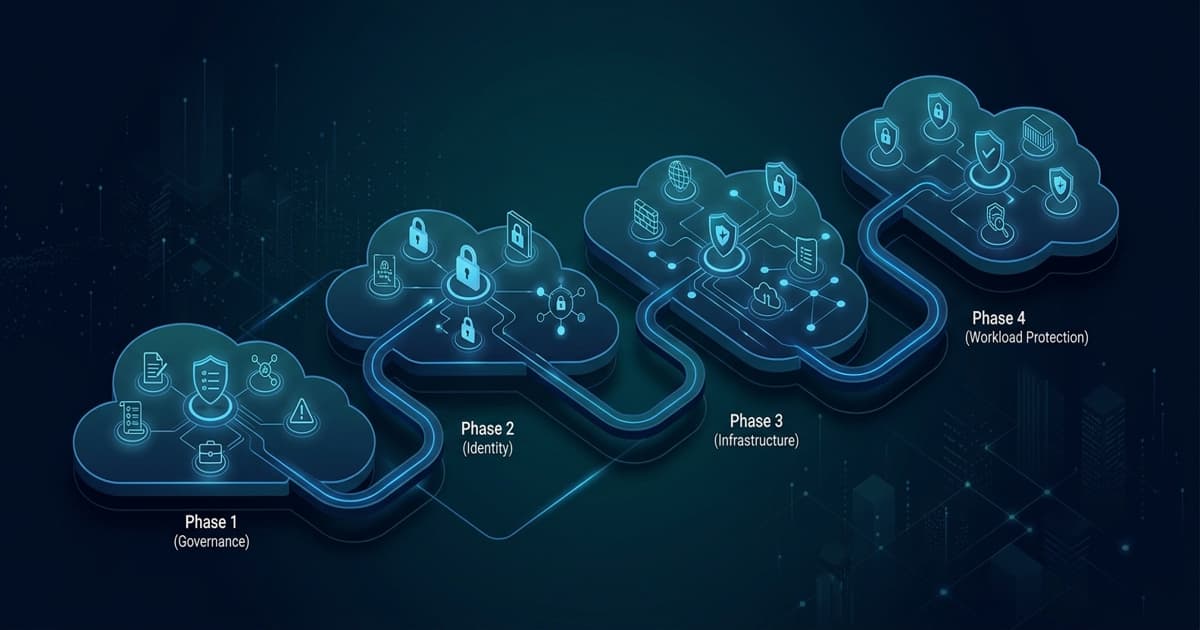
Cloud security services are no longer optional for enterprises operating across public, private, hybrid, and multi-cloud environments. As organizations migrate critical workloads and sensitive data into the cloud, security teams face increasing pressure to maintain consistent governance, regulatory compliance, and visibility across distributed infrastructure. Without a structured cloud security roadmap, security controls become fragmented, gaps multiply, and organizations are exposed to serious financial and reputational risk.
A cloud security roadmap gives security leaders a phased, strategic plan that aligns security investments with business objectives, compliance requirements, and operational risk tolerance. This article walks through the essential stages of building that roadmap and explains how enterprise cybersecurity services support its execution from initial assessment through continuous monitoring and improvement.
Key Takeaways
Cloud security services provide the expertise, tooling, and governance support enterprises need to execute a structured security roadmap without overburdening internal IT teams.
A structured cloud security roadmap enables enterprises to systematically address misconfigurations, unauthorized access, data exposure, and compliance gaps across complex cloud environments.
Engaging experienced cloud consulting providers and a cloud security solutions company accelerates roadmap development by bringing governance frameworks, threat intelligence, and compliance expertise.
Cloud security is a continuous capability, not a one-time project. Ongoing cloud workload protection, posture management, and monitoring are essential for long-term resilience.
Why Enterprises Need Cloud Security Services and a Roadmap Today
The scale and complexity of modern enterprise cloud environments make uncoordinated security efforts ineffective. Cloud security services delivered by experienced providers give organizations consistent controls, policy enforcement, and threat detection capabilities that span every layer of the cloud stack. Without a formal roadmap anchored to proven cloud security services, organizations risk deploying siloed tools that do not interoperate, leaving dangerous gaps between security domains.
A well-constructed roadmap also helps enterprises justify security investments to executive leadership by tying each initiative to specific business risks and compliance obligations. According to Gartner, misconfiguration remains one of the leading causes of cloud security incidents, reinforcing the need for a deliberate, phased approach to security planning. Enterprises in regulated sectors such as finance and healthcare can explore foundational principles of cloud security services that strengthen enterprise operations in hybrid environments to understand how these principles apply across on-premise and cloud boundaries.
Stage One: Cloud Security Assessment and Risk Identification
Every effective cloud security roadmap begins with a thorough assessment of the current cloud environment. Security teams must inventory all cloud assets, including infrastructure services, storage buckets, databases, applications, and third-party integrations. This discovery phase uncovers shadow IT, unmanaged cloud accounts, and misconfigured resources that represent immediate risk.
Risk identification follows the inventory. Security teams evaluate each asset against known threats such as unauthorized access, data exposure, privilege escalation, and compliance violations. Partnering with a cloud managed service provider experienced in cloud security posture management tools helps organizations systematically surface misconfigurations and prioritize remediation based on business impact and risk severity.
Stage Two: Establishing Cloud Governance Frameworks and Security Policies
After risk identification, organizations must establish a governance foundation that defines accountability, security controls, and policy enforcement across all cloud environments. This stage involves selecting appropriate security frameworks such as the NIST Cybersecurity Framework, ISO 27001, or the CIS Cloud Security Benchmark, and mapping organizational policies to those standards. Governance frameworks define who can access what, how data is classified and protected, and how security incidents are escalated and resolved.
Cloud governance is not a technology problem alone. It requires cross-functional alignment between IT, legal, compliance, and executive leadership. Security policies must address identity and access management, data sovereignty, encryption standards, and vendor risk management. A cloud security solutions company can accelerate this stage by delivering pre-built governance templates, policy libraries, and compliance mapping tools tailored to regulatory environments such as UAE NESA, GDPR, PCI DSS, and ISO standards.
Stage Three: Identity, Access Management, and Network Security
Identity and access management (IAM) is a foundational layer of any cloud security roadmap. Enterprises must implement the principle of least privilege, enforce multi-factor authentication, and continuously audit access permissions across all cloud platforms. Privileged access must be tightly controlled using just-in-time access mechanisms and session monitoring tools that detect and respond to anomalous behavior in real time.
Network security solutions must also be embedded at this stage. This includes configuring virtual private clouds, network segmentation, micro-segmentation between workloads, secure API gateways, and cloud-native firewalls. Enterprises operating across hybrid and multi-cloud architectures need to enforce consistent network security policies regardless of where workloads reside. Layered identity and network security controls ensure that policy enforcement follows workloads across cloud boundaries rather than remaining anchored to a fixed perimeter.
How Zero Trust Principles Strengthen the Cloud Security Roadmap
Zero Trust architecture integrates naturally into a cloud security roadmap by enforcing continuous verification of every user, device, and workload requesting access to cloud resources. Zero Trust removes implicit trust from any network segment and replaces it with identity-centric policy enforcement backed by behavioral analytics. This approach is especially effective in multi-cloud environments where perimeter-based security models fail to provide adequate coverage.
Implementing Zero Trust requires coordinated effort across IAM, endpoint security, network security, and data classification. The Zero Trust model treats every access request as potentially hostile and requires continuous authentication, least-privilege enforcement, and micro-segmentation to contain lateral movement across cloud environments.
Stage Four: Cloud Workload Protection and Data Security
Cloud workload protection covers the security of compute instances, containers, serverless functions, and virtual machines running within cloud environments. As workloads become more dynamic and ephemeral, traditional security tools designed for static infrastructure cannot provide adequate coverage. Enterprises need workload protection platforms that offer runtime threat detection, vulnerability scanning, container security, and automated response capabilities.
Data security must run in parallel with workload protection. Organizations should implement data classification frameworks that identify sensitive data across cloud storage, databases, and data pipelines. Encryption must be enforced at rest and in transit, with key management policies that prevent unauthorized decryption. Data loss prevention controls and cloud access security broker solutions add additional layers of protection by monitoring and controlling how data moves across cloud services and external endpoints.
Managing Cloud Security Across Multi-Cloud and Hybrid Environments
One of the most significant challenges enterprises face is maintaining consistent security controls across multi-cloud and hybrid environments. Each cloud provider offers native security tools, but these tools are not interoperable, which creates visibility gaps and management complexity. A unified cloud security management platform gives security teams a single pane of glass across AWS, Azure, Google Cloud, and private cloud environments.
Enterprises working with experienced cloud consulting providers gain access to multi-cloud security architectures, integration blueprints, and vendor-neutral security tooling recommendations that eliminate fragmentation. This is critical for organizations in the UAE where regulatory mandates require consistent security controls and audit trails across all technology environments.
Stage Five: Compliance Management and Regulatory Alignment
Compliance management is an ongoing discipline within the cloud security roadmap, not a one-time certification exercise. Enterprises must continuously monitor cloud configurations and access controls against regulatory benchmarks and update their controls as regulations evolve. Compliance frameworks such as UAE NESA, ISO 27001, SOC 2, and PCI DSS require organizations to demonstrate continuous adherence rather than point-in-time compliance.
Cloud-native compliance management tools automate policy checks, generate audit-ready reports, and alert security teams when configurations drift from approved baselines. Enterprise cybersecurity services that include compliance advisory, audit support, and continuous monitoring reduce the operational burden on internal teams while ensuring regulatory readiness. Organizations in sectors with strict data sovereignty requirements must also confirm that cloud provider configurations align with data residency obligations applicable in their jurisdiction.
Stage Six: Continuous Monitoring, Threat Detection, and Cloud Security Optimization
A cloud security roadmap is a living framework that must evolve as cloud environments grow and threats change. The final and most operationally intensive stage involves deploying continuous monitoring tools, establishing security operations center capabilities, and integrating threat intelligence feeds that surface emerging attack patterns targeting cloud infrastructure. Security information and event management platforms, combined with cloud-native detection tools, provide real-time visibility into security events across all cloud environments.
Threat detection must be complemented by automated response playbooks that contain incidents quickly and reduce dwell time. Security teams should conduct periodic red team exercises and cloud-specific penetration testing to validate the effectiveness of security controls. Regular roadmap reviews allow organizations to adapt their cloud security strategy to new business requirements, technology changes, and evolving regulatory obligations. This continuous improvement mindset is what separates mature enterprise cloud security services programs from reactive, tool-focused approaches.
How Cloud Security Services Accelerate Roadmap Execution
Qualified cloud security services provide the expertise, tooling, and governance support that allow enterprises to execute their roadmap efficiently without overburdening internal IT teams. A qualified cloud managed service provider delivers continuous threat monitoring, compliance management, incident response, and security posture optimization as ongoing managed services. This model gives organizations access to specialized cloud security talent and advanced security technologies without the cost and complexity of building those capabilities entirely in-house.
Selecting the right cloud security partner requires evaluating their experience across your specific cloud platforms, their alignment with relevant compliance frameworks, and their ability to integrate security services with your existing IT environment. The security partner should function as an extension of your internal team, contributing strategic guidance alongside operational security management. This collaborative model supports the long-term evolution of the cloud security roadmap as business requirements and threat landscapes change over time.
Conclusion: Building Cloud Security as a Long-Term Enterprise Capability
Building a robust cloud security roadmap supported by reliable cloud security services is one of the most strategic investments an enterprise can make as cloud adoption accelerates. From initial assessment and risk identification through governance, identity management, cloud workload protection, compliance alignment, and continuous monitoring, every stage of the roadmap contributes to a stronger, more resilient cloud security posture. Organizations that treat cloud security as a continuous capability rather than a project will be far better positioned to manage risk, satisfy regulators, and scale their cloud environments with confidence.
Frequently Asked Questions
What is a cloud security roadmap and why does an enterprise need one?

What are the first steps in building a cloud security roadmap?
How do cloud security services support roadmap execution?
What role does a cloud managed service provider play in cloud security?
How does cloud workload protection fit into the cloud security roadmap?
What compliance frameworks should enterprises include in their cloud security roadmap?
How does Zero Trust architecture strengthen a cloud security roadmap?
What are the most common cloud security challenges enterprises face?
How should enterprises approach network security in cloud environments?
How often should enterprises review and update their cloud security roadmap?