Cloud Workload Protection for BFSI: Securing Multi-Cloud Workloads Without Slowing Deployment

Financial institutions arrive at multi-cloud by accretion rather than design. A core platform lands on one provider, an analytics programme chooses another because of a specific service, an acquisition brings a third, and within two years the security team is asked to protect workloads across three control planes with different identity models, different logging formats and different defaults. Cloud workload protection is the discipline that makes that estate governable, and the reason it frequently fails in BFSI is not technical. It is that controls get added at the end of the delivery pipeline, where they slow releases, rather than at the start, where they prevent the problem. This article covers what to protect, where to place the controls, and what supervisors ask to see. Our step-by-step enterprise cloud security roadmap covers the wider programme.
Key Takeaways
- Workload protection has to cover build, deploy and runtime. Controls placed only at runtime detect problems that were cheaper to prevent two stages earlier.
- Multi-cloud governance works through a common control set expressed once and enforced natively on each provider, not through a lowest-common-denominator abstraction layer.
- For BFSI the evidence requirement is as important as the control. Every enforcement decision needs a durable record that names the workload, the policy and the outcome.
What Actually Needs Protecting
The workload is the unit that matters, and in a modern BFSI estate it takes several forms. Virtual machines running core applications. Containers orchestrated across clusters. Serverless functions triggered by events. Managed database and messaging services. Each has a different threat profile and a different set of available controls, and treating them as one category produces coverage gaps at the seams.
Underneath all of them sits the control plane, which is frequently the least protected and the most consequential. An attacker with sufficient control plane permissions does not need to compromise a workload; they can create, modify or destroy them directly. Cloud workload protection that secures the workloads and ignores the plane above them has secured the wrong layer.
The image and dependency supply chain is the third area. Container images pull base layers and packages from external registries, and a compromised or simply outdated dependency reaches production with the application. In financial services this is a regulatory concern as much as a technical one, because the institution is accountable for code it did not write.
Finally there is configuration drift. A workload deployed correctly can be modified afterwards, by an operator during an incident or by an automation script, and the deviation frequently persists silently until an audit. Detecting drift against the declared state matters as much as validating the initial deployment.
Mapping these four areas against a recognised control framework, such as the Cloud Controls Matrix, gives a structure that translates cleanly into supervisory conversations later.
Shifting Controls Left Without Slowing Delivery
The complaint that security slows deployment is usually accurate and usually self-inflicted. When the only enforcement point is a gate before production, every issue is discovered at the most expensive moment, and the security team becomes the reason a release is late. Moving enforcement earlier fixes both problems simultaneously.
In the build stage, scan images and dependencies as part of the pipeline and fail the build on defined conditions rather than warning. Developers respond to a failed build immediately and to a report never. Keep the failing conditions narrow and unambiguous at first, typically critical vulnerabilities with an available fix and any embedded secret, then widen as the estate improves.
In the deploy stage, validate infrastructure definitions against policy before provisioning. A storage bucket without encryption, a security group open to the internet or a role with administrative permissions should be rejected by the pipeline rather than created and remediated. This is where the majority of cloud misconfiguration findings are prevented outright.
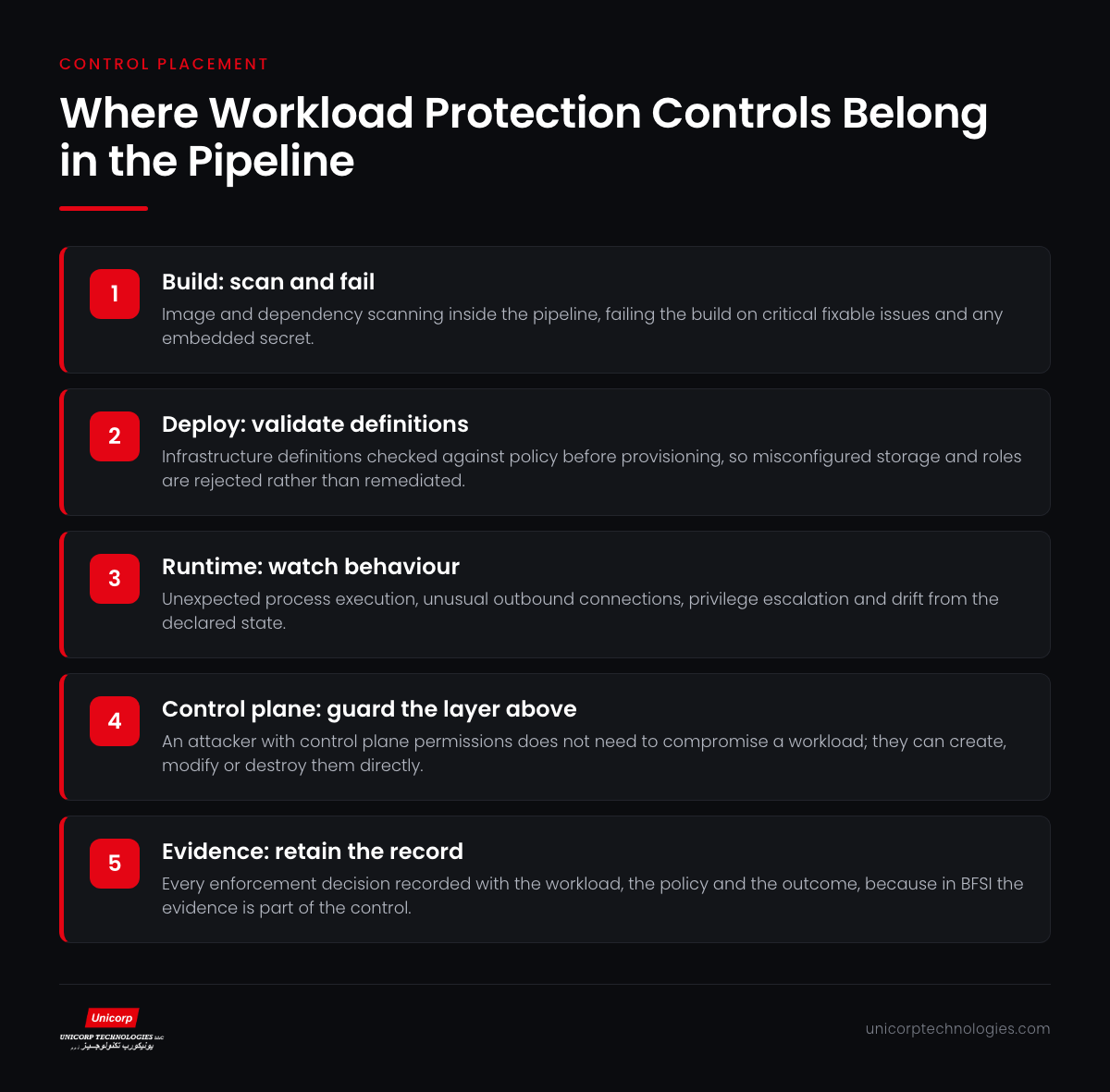
At runtime, focus on behaviour rather than on configuration that earlier stages already validated. Unexpected process execution, unusual outbound connections, privilege escalation attempts and drift from the declared state are the signals worth alerting on. Duplicating build-stage checks at runtime generates noise and finds nothing new.
Governing Across Multiple Providers
The instinct in multi-cloud is to build an abstraction layer so that one policy applies everywhere. In practice this produces a lowest common denominator that under-uses each provider's native capability and creates a dependency nobody wants to maintain. The better pattern is a common control set expressed once in policy language and implemented natively on each platform.
Write each control as an outcome rather than a mechanism. Data at rest must be encrypted with keys the institution controls is portable; enable a specific provider service is not. The outcome statement then maps to whichever native capability delivers it, and the mapping is documented so that an auditor can follow it from policy to implementation on each cloud.
Identity is where multi-cloud complexity concentrates. Each provider has its own model, and the temptation to create long-lived access keys for cross-cloud automation is strong and should be resisted. Federated identity with short-lived credentials, issued by a central provider and consumed by each cloud, keeps the account inventory manageable and removes the standing keys that turn up in assessments.
Logging needs deliberate normalisation. Control plane logs from three providers arrive in three formats with different field names and different event vocabularies, and a detection written against one will not fire on the others. Normalising at ingestion, into a common schema, is unglamorous work that determines whether your detection coverage is real or nominal.
Our note on secure and efficient application migration to cloud providers covers the migration decisions that shape this landscape.
BFSI-Specific Requirements
Financial institutions carry obligations that change the design rather than adding to it. Data residency determines where workloads and their backups may run, and the answer has to hold for logs and telemetry as well as for primary data, which is frequently overlooked when a monitoring service defaults to a region outside the country.
Segregation of duties has to be enforced technically rather than procedurally. The engineer who writes a deployment definition should not be able to approve and apply it unilaterally to a production environment holding customer data. In a pipeline-driven estate this means the approval gate lives in the pipeline with its own identity requirements, not in a document describing who should ask whom.
Change evidence is a standing requirement. Every production change needs a durable record: what changed, who approved it, which policy checks ran and what they returned. Pipelines produce this naturally if configured to retain it, and retrofitting it later is considerably harder than enabling it at the start.
Third-party and provider concentration is the fourth. Where several critical services depend on one cloud region or one managed service, the institution carries correlated risk that individual contracts do not address, and supervisors increasingly ask what the contingency is. Our note on seamless cloud transformation with a UAE migration provider covers the planning side.
Provider guidance is worth aligning to rather than reinventing. The published well-architected material from the major platforms, such as the AWS Well-Architected Framework, sets out the security pillar in terms most supervisors already accept.
Making the Programme Deliverable
Start with an inventory of workloads by type and by criticality, because coverage decisions cannot be made without it. Most institutions find they have more serverless functions and more container clusters than the architecture documentation records, and several running in accounts nobody has reviewed.
Then pick one application team and implement the full build, deploy and runtime control set with them end to end. Working through one team surfaces every practical obstacle, from base image availability to pipeline permissions, and produces a pattern the next team can adopt in days rather than months.
Sequence the remaining teams by criticality and by how much change they are already absorbing. A team midway through a core platform migration is the wrong first adopter, however important the application, and a team shipping frequently with a modern pipeline is the right one because they will hit and resolve the problems fastest.
Treat exceptions as time-bound from the start. Legacy workloads that cannot meet the standard need a documented owner, a compensating control and a review date. Effective cloud workload protection is not universal coverage on day one; it is complete visibility of where coverage does not yet reach and why.
If you want a review of your current multi-cloud control coverage against these expectations, our cloud security team can run the assessment with you. You can also see how our infrastructure and data platform practice supports multi-cloud estates in regulated sectors.
Measuring Whether It Is Working
Coverage is the first measure and should be expressed as a proportion of workloads by criticality rather than as a raw count, because a hundred protected development functions and two unprotected production databases is not good coverage.
Prevention rate is the second and the most useful for arguing that the programme is not slowing delivery. Count issues caught at build and deploy against issues found at runtime. A healthy ratio moves steadily toward the earlier stages, which is the evidence that shifting controls left is working.
Drift rate is the third. How often does a running workload deviate from its declared configuration, and how long before it is corrected. High drift usually indicates that engineers are working around a pipeline that is too slow or too restrictive, which is a process finding rather than a compliance one.
Time-to-remediate by severity band completes the set, tracked separately for each cloud so that a provider where coverage is weaker shows up rather than being averaged away with the others.
Report all four to the same committee that reviews operational risk. Cloud workload protection presented as a security metric competes for attention; presented as operational risk coverage for the platforms the business runs on, it gets the attention and the funding it needs.
Frequently Asked Questions
What exactly is a workload in this context?

Why is the control plane so important?
Does adding security controls slow deployment?
Should we build an abstraction layer across clouds?
How should cross-cloud identity be handled?
Why does log normalisation matter so much?
What do BFSI supervisors ask to see?
How do we start without stalling delivery?
What should we measure?