Data Loss Prevention in Dubai: DIFC and Onshore Guide

Data loss prevention projects in Dubai often begin with a product demo, when they should begin with a legal question: which data protection law applies to this entity? A mainland company and a firm registered in the Dubai International Financial Centre can run the same tool and still face different regulators and different reporting routes. A rollout that ignores this produces clean dashboards and a confused incident response. This guide shows how to map the regime first, then scope channels, tune policy and route incidents so the programme holds up when something actually leaves the building.
Key Takeaways
- Map every legal entity to its data protection regime before writing a single policy, because the regime decides the regulator and the reporting route.
- Run in monitor mode first, and enforce only the rules that have proven reliable. Noisy blocking is the main reason rollouts get switched off.
- Decide before an incident who reviews an alert, who calls legal and who speaks to the regulator.
Data Loss Prevention in Dubai Starts With the Legal Map
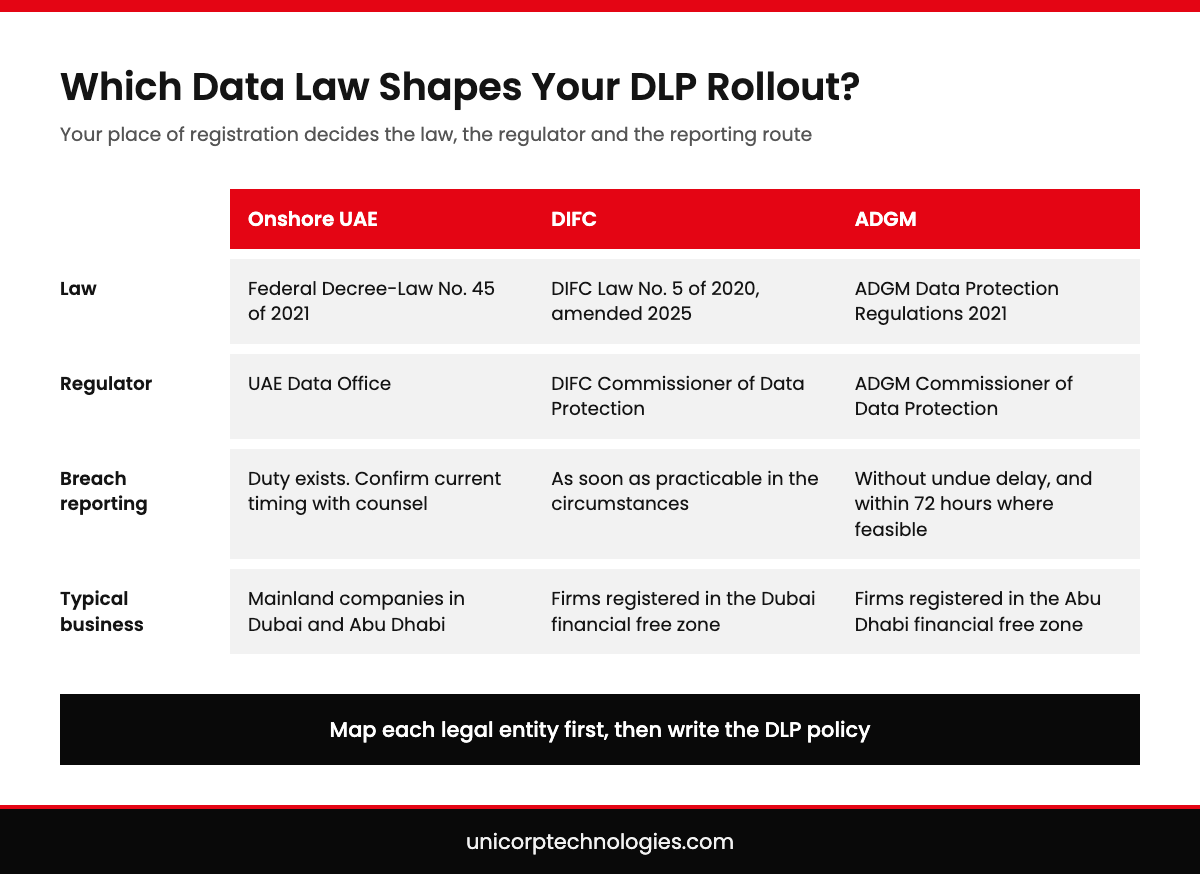
Dubai businesses do not all sit under one data protection law. According to Simmons and Simmons' guide to the federal law, Federal Decree-Law No. 45 of 2021 covers controllers and processors in the UAE, as well as foreign ones processing data about people in the country. The free zones with their own data protection regulations sit outside it.
Those free zones include the DIFC in Dubai and ADGM in Abu Dhabi. DIFC entities answer to the DIFC Commissioner of Data Protection under DIFC Law No. 5 of 2020. That law changed in July 2025, when an amendment took effect that added a private right of action in the DIFC Courts and widened the law's scope.
A group with a mainland operating company and a DIFC holding company may therefore have two answers to the same incident. So may a business with teams in Dubai and an ADGM entity in Abu Dhabi. List every entity, the regime it falls under and the personal data it holds. This takes a workshop with legal and IT, and it stops the data protection strategy resting on an assumption.
Some regulated activities add further obligations. Banks, healthcare providers and Dubai government entities each have sector rules that sit alongside general data protection law. Dubai Government Entities, for example, work under the Dubai Electronic Security Center's Information Security Regulation. Record these on the same map so nobody discovers them during an incident.
The status of the federal rules needs a current check too. Law firm commentary from late 2025 still described the federal Executive Regulations as pending, and other sources make conflicting claims. Ask counsel to confirm the position on your project start date, and to review it again before any enforcement decision.
None of this is a reason to wait. Classification, channel coverage and evidence are worth building under any version of the rules. The map simply tells you which regulator receives the phone call, and which standard your records will be measured against.
What Each Regime Means for Incident Reporting
Breach reporting is where the legal map changes the design of the programme. A February 2026 Legal 500 overview describes the DIFC duty as notifying the Commissioner as soon as practicable in the circumstances. For ADGM, it describes notification without undue delay and, where feasible, within 72 hours.
The federal law also carries a notification duty. K&L Gates noted in 2022 that the law itself set no specific timeline, so treat any fixed number you see quoted online as something to verify. Your legal team should confirm current wording before the response plan is signed off.
For security teams, the practical point is speed of evidence. A regulator's clock only helps if you can establish what data moved, whose data it was, where it went and whether it can be recovered. Data security systems that record those facts at the time of the event save days of reconstruction later.
Build the alert path around that need. A high severity alert should reach a named reviewer, who can escalate to a named legal contact without waiting for a meeting. Write down who makes the decision to notify, and who deputises on a public holiday.
Ownership also has to be practical across locations. A group with teams in Dubai and Abu Dhabi may need one security reviewer and two legal routes, depending on which entity held the data. Write that down, because data loss prevention alerts rarely arrive at a convenient moment. Test this before you need it. A one hour tabletop exercise using a realistic scenario, such as a customer file emailed to a personal account, will reveal more than a policy review. Time each step and record which facts were hard to find.
Scoping Channels for a Data Protection Enterprise Programme
A data protection enterprise programme covers more channels than a first phase can handle. PwC's 2027 Global Digital Trust Insights found that 48% of organisations have data loss prevention across key egress channels. Coverage is hard, so choose the order deliberately.
Start with the routes that carry the most sensitive data out of the business. For most Dubai firms that means email, sanctioned cloud storage and web uploads. Endpoints, removable media and printing usually come next. Each additional channel adds tuning work, so add it only once the previous one runs steadily.
Then decide what you are protecting. Three or four data classes are enough to begin: customer personal data, financial records, regulated data and commercially confidential material. A policy built on a clear class such as passport numbers on customer records will outperform a long list of generic patterns.
Use your existing systems to find where those classes live, because data loss prevention rules only protect data you have located. Customer platforms, finance systems, shared drives and SaaS applications all count. Our note on preventing cloud and insider leaks covers the wider control set that sits around this work.
Include contractors and outsourced teams in scope from day one. They often hold broad access, use their own devices and sit outside the awareness programme. If they can reach regulated data, the policy has to reach them too.
Generative AI belongs on the channel list as well. Treat prompts and file uploads like any other outbound route, and read why older controls miss generative AI uploads before assuming your current rules see them. Good ai data leakage prevention relies on the same classes and the same exception process as the rest of the programme.
Tuning Data Loss Prevention So It Stays Switched On
Run every new rule in monitor mode first. Two to four weeks of observation shows which business processes legitimately send sensitive data, and which rules misfire. Skipping this step is the fastest way to block a finance run and lose executive support.
Enforce gradually. Move from silent monitoring to on screen coaching, then to a block with a justified override, and finally to a hard block for the narrow cases that warrant it. Most accidental exposure stops at the coaching stage, because people correct themselves when prompted.
Give every exception an owner, a reason and an expiry date. Exceptions without dates become permanent gaps, and a policy with hundreds of them protects very little. Review the list monthly and remove anything that no longer has a business owner.
Measure outcomes instead of alert counts. Useful measures include the share of channels covered, the false positive rate per rule, median time to review a high severity alert, and the number of exceptions past their expiry date. These numbers show whether the programme is getting better.
Assign the work properly. Security can run the tool, but business owners must decide what counts as acceptable use of their data. When security alone makes those calls, staff see the control as obstruction and start looking for routes around it.
Plan for capacity before enforcement starts. Someone has to review alerts every day, including during holidays and peak trading periods. If you do not have that person, discuss it with your shortlisted cyber security company in Dubai before the licence is signed, and make the review service part of the contract.
Conclusion
Effective data loss prevention in Dubai begins with knowing which law applies to each entity, then building channel coverage, tuned policy and a tested incident route around that answer. Start with the channels that carry the most sensitive data, stay in monitor mode until the rules earn trust, and record the facts a regulator will ask for. Legal requirements will continue to develop, so have counsel review them on a set schedule. To scope a first phase with people who work in both emirates, talk to Unicorp's data security practice or arrange a discovery session.
Frequently Asked Questions
What is data loss prevention?

Which data law applies to my Dubai business?
How quickly must a DIFC firm report a personal data breach?
Does data loss prevention need the law to be finalised first?
Should a rollout start in blocking mode?
Which channels should come first?
How does this apply to generative AI tools?
What should a DLP incident record contain?
How can Unicorp help?