Disaster Recovery Audit and Testing: Are Your NESA Backups Ransomware-Proof?
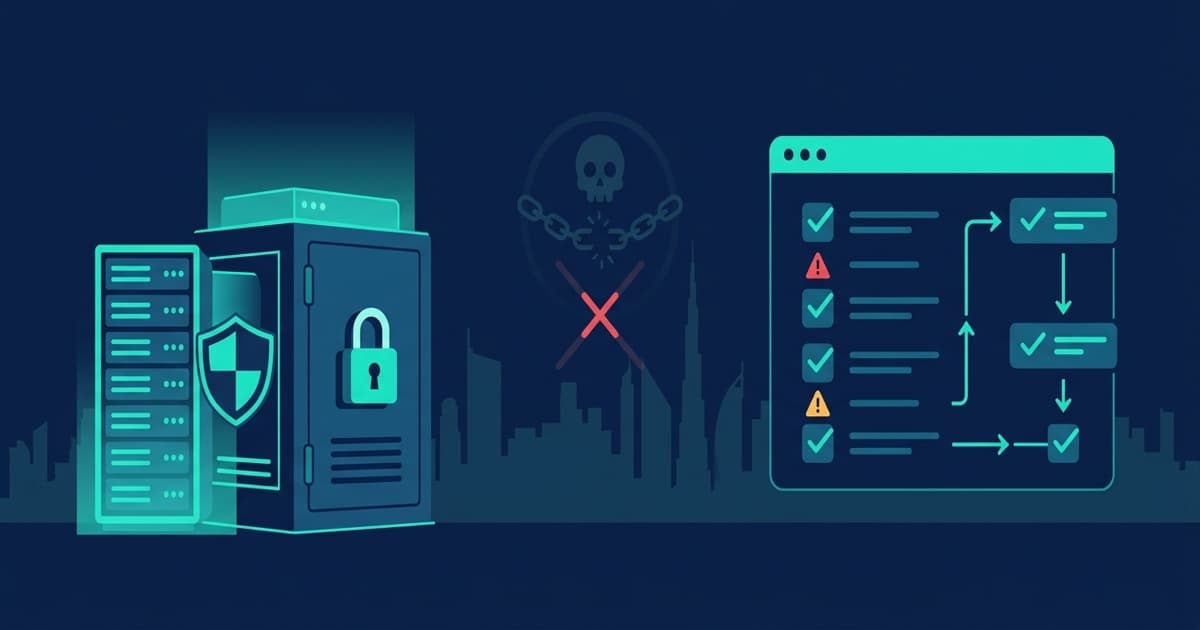
Disaster recovery audit and testing is no longer a checkbox on an annual compliance form. It is the difference between an organization that survives a ransomware attack and one that pays the ransom because its backups were already compromised. Most UAE enterprises can point to a documented DR plan and a NESA compliance certificate. Far fewer can prove that their restored data is actually clean.
This article walks through why that gap exists, what modern attackers are doing to exploit it, and what a provable, tested recovery program looks like in 2026. If you are a CISO, IT Director, or compliance officer, the numbers below are worth reading before your next board briefing.
Key Takeaways
Ransomware now appears in 44% of all data breaches, up from 32% the prior year, and attackers deliberately target backup infrastructure before launching a visible attack.
A NESA-compliant DR plan is a starting point, not a finish line. Tested, immutable, clean-room-verified recovery is what actually meets the spirit of NESA IAS requirements.
A structured disaster recovery audit and testing program, backed by managed disaster recovery services, closes the gap between documented RTO/RPO metrics and real-world ransomware resilience.
Why NESA Compliance Does Not Equal Ransomware Resilience
NESA IAS requires organizations to maintain tested BCP/DR plans with defined RTO and RPO targets and redundancy for critical systems. That is a sound framework. The problem is that compliance audits verify documentation and process, not outcome. An auditor confirms that a restore procedure exists. They rarely confirm that the restored environment is free of dormant malware.
According to the Verizon 2025 Data Breach Investigations Report, ransomware is now present in 44% of all breaches, up from 32% the year before. More critically, ransomware operators now target backup infrastructure first. Malware can lie dormant for weeks before an attack becomes visible, meaning the most recent backup snapshot is often already infected by the time the encryption event triggers.
A NESA certificate tells regulators that your policy is in order. It does not tell your board that you can recover clean data on a Monday morning after a Friday night attack.
The Numbers That Should Concern Every UAE IT Leader
The confidence gap in enterprise recovery is well documented. Research from Scality's 2026 Cyber Resilience Trends report found that 90% of security leaders are confident they can meet their RTO targets, yet more than 40% of organizations that experienced a recent incident reported service disruption and 41% reported direct financial loss. Confidence and capability are not the same thing.
IBM's Cost of a Data Breach 2025 report adds another dimension: the average recovery time following a breach now exceeds 100 days. If your DR plan promises a four-hour RTO and your actual recovery took over three months, the gap is not a technical misconfiguration. It is a structural failure in how recovery was designed, tested, and maintained.
UAE-specific risk has also escalated. In early 2026, UAE authorities confirmed coordinated ransomware campaigns against critical infrastructure, including AI-enabled phishing attacks and an alleged breach at American Hospital Dubai, as reported by TahawulTech in May 2026. The threat is regional, active, and increasingly sophisticated.
How Ransomware Operators Defeat Traditional Backup Strategies
Understanding the attack pattern changes the way you design recovery. Ransomware groups no longer simply encrypt production data and demand payment. Their playbook has evolved into three deliberate phases.
Phase 1: Dwell and reconnaissance. After initial access, attackers spend days or weeks mapping the environment, identifying backup systems, storage repositories, and administrative credentials.
Phase 2: Backup neutralization. Before triggering the encryption event, attackers delete shadow copies, corrupt backup catalogs, exfiltrate data, or inject malware into backup sets. By the time the attack is visible, the most recent backups are already compromised.
Phase 3: Encryption and extortion. The visible attack is actually the final phase. At this point, organizations reach for backups that are no longer clean.
This pattern was highlighted in a July 2026 analysis by Blocks and Files, which noted that ransomware operators specifically target backup infrastructure because eliminating recovery options dramatically increases the probability of payment. A traditional cloud backup and recovery strategy that lacks immutability and clean-room verification is a direct vulnerability, not a safeguard.
What a Real Disaster Recovery Audit and Testing Program Looks Like in 2026
A genuine disaster recovery audit and testing program addresses four distinct requirements that go beyond what most annual compliance reviews cover.
1. Immutable Backup Storage
Backups must be stored in a way that attackers, administrators, and malware cannot modify or delete them. Immutable object storage with WORM (Write Once Read Many) policies, air-gapped or offline copies, and cryptographic integrity verification are now baseline requirements for any organization exposed to ransomware risk. Cyber security companies in UAE offering enterprise-grade managed disaster recovery services should be able to demonstrate these controls are in place, not just documented.
2. Clean-Room Verified Restores
A restore test that runs inside the production environment proves almost nothing. A clean-room restore spins up an isolated network segment, restores the backup, runs malware and integrity scans against the restored data, and validates that applications function correctly before any connection to production systems is made. This is the only method that answers the question that actually matters: is the restored data clean?
3. Tested, Not Theoretical, Failover
Documented RTO and RPO figures that have never been validated under realistic conditions are aspirational numbers, not operational commitments. A credible disaster recovery planning program requires scheduled, full failover tests at least once per year, tabletop exercises quarterly, and continuous monitoring of backup job completion and integrity. NESA IAS requires tested BCP/DR plans, meaning tested in practice, not tested in theory.
4. A Structured Disaster Recovery Risk Assessment
Recovery objectives only mean something if they are mapped to actual business impact. A formal disaster recovery risk assessment identifies which systems are truly critical, what the financial and regulatory cost of each hour of downtime is, and whether current RTO/RPO commitments are achievable given the actual state of backup infrastructure. Without this mapping, organizations are making recovery promises they cannot substantiate.
Unicorp Technologies delivers structured assessments as part of its business continuity solutions, helping UAE enterprises move from documented DR plans to verified, tested recovery capabilities. Our team works with CISOs and IT Directors to map recovery objectives to real business risk, implement immutable backup controls, and conduct clean-room restore testing that satisfies both board-level scrutiny and NESA audit requirements. To understand how Unicorp approaches enterprise resilience, explore our leadership team's approach to UAE cybersecurity.
How Often Should DR Plans Be Tested Under NESA?
NESA IAS does not prescribe a fixed testing cadence in absolute terms, but the standard's intent is clear: plans must be tested, results must be documented, and gaps identified during testing must be remediated. In practice, leading organizations in regulated UAE sectors follow a tiered testing schedule.
Tabletop exercises: Quarterly, involving IT, security, legal, and executive stakeholders.
Partial failover tests: Biannually, covering critical system recovery within defined RTO windows.
Full clean-room restore tests: Annually at minimum, with ransomware simulation scenarios included.
Continuous monitoring: Automated backup job verification, integrity checks, and anomaly detection running at all times.
Organizations that treat DR testing as an annual event are accepting a risk posture that does not reflect the current threat landscape. Given that ransomware dwell times can exceed 30 days, a backup set that was verified clean three months ago may already be compromised today.
Choosing the Right Managed Disaster Recovery Services in the UAE
Not all managed disaster recovery services are equivalent. When evaluating providers, UAE enterprises should ask specific, direct questions rather than accepting a capabilities brochure at face value.
Can you demonstrate immutable storage with documented WORM policies and air-gap controls?
Do you conduct clean-room restore tests, and can you share documented results?
How do you detect and handle ransomware that has infected a backup set?
What is your tested RTO for our specific workload profile, not a generic SLA figure?
How do your services map to NESA IAS BCP/DR requirements?
Unicorp Technologies has operated in the UAE cybersecurity space since 2008, working with enterprises across finance, healthcare, government, and telecommunications. Our team is available to discuss your current DR posture, identify gaps against NESA requirements, and design a recovery architecture that holds up under real attack conditions, not just audit conditions.
Conclusion: Compliance Is a Baseline, Recovery Is the Goal
A disaster recovery audit and testing program that meets NESA requirements on paper but fails under ransomware conditions is not a compliance asset. It is a liability waiting to be activated. The data is clear: recovery times exceed 100 days on average, backup infrastructure is now a primary attack target, and the confidence most security leaders have in their RTO commitments is not supported by real-world outcomes.
The answer is not more documentation. It is immutable storage, clean-room verified restores, tested failover, and a structured disaster recovery risk assessment that maps recovery objectives to actual business risk. Unicorp Technologies provides exactly that through its managed disaster recovery and business continuity solutions, built for the UAE regulatory environment and the current ransomware threat landscape. If your organization needs to move from a compliance certificate to a provable recovery capability, contact Unicorp Technologies to start the conversation.
Frequently Asked Questions
What is the difference between a NESA-compliant DR plan and a ransomware-proof recovery strategy?

How does ransomware target backup infrastructure before an attack becomes visible?
What does NESA IAS require for disaster recovery and business continuity?
What is a clean-room restore test and why does it matter for ransomware recovery?
How often should UAE enterprises conduct disaster recovery testing under current threat conditions?
What questions should I ask a managed disaster recovery services provider in the UAE?
Why do most organizations fail to meet their RTO targets after a ransomware attack?
What is an effective disaster recovery risk assessment for UAE enterprises?
How does immutable backup storage protect against ransomware operators targeting backup systems?
What role do cyber security companies in UAE play in building ransomware-resilient recovery?