DRaaS for Enterprise: How PureStorage Keeps BFSI Operations Running Through Ransomware
DRaaS providers are becoming the default choice for banks and financial institutions that cannot afford a multi week rebuild after a ransomware attack. Building and testing an in house disaster recovery environment takes specialist staff, duplicate infrastructure and constant testing that most BFSI IT teams struggle to prioritize until an incident forces the issue. PureStorage's immutable snapshots and rapid restore capabilities give managed DRaaS providers a faster recovery path than most in house rebuilds achieve. This guide explains why BFSI operations increasingly outsource disaster recovery, and what PureStorage specifically changes about the recovery timeline.
Key Takeaways
- Industry research shows the average ransomware recovery still takes about three weeks when organizations rebuild without a tested, automated recovery path, a timeline most BFSI operations cannot absorb.
- DRaaS providers built on immutable, policy driven snapshots remove the manual, error prone steps that slow down in house recovery, without requiring a bank to staff and maintain duplicate infrastructure.
- Backup based recovery adoption is rising industry wide, but adoption alone does not guarantee fast recovery unless the underlying storage architecture supports rapid, verified restores.
Why BFSI Ransomware Recovery Is a Business Continuity Problem
When ransomware encrypts a bank's core systems, the clock that matters is not how fast IT can rebuild a server, it is how fast the institution can resume processing transactions and meeting regulatory reporting deadlines. That framing changes how BFSI leadership should evaluate disaster recovery services.
A ransomware incident at a bank does not stay contained to IT. Customer facing transaction systems, regulatory reporting pipelines and internal settlement processes all depend on the same infrastructure an attacker just encrypted. Every hour of downtime compounds into missed service level commitments, regulatory reporting delays and customer facing outages that a bank has to disclose. This is why disaster recovery services for BFSI institutions need to be evaluated on business continuity terms, not purely technical ones. The question is not whether backups exist, most institutions already have backups. The question is how quickly those backups translate into a running, verified production environment that customers and regulators can rely on again. Framing recovery this way is what pushes many BFSI institutions toward managed disaster recovery services instead of an internally built environment that gets tested once a year, if at all. For a broader look at building enterprise resilience, see Unicorp's earlier piece on disaster recovery services for data centers and its overview of hybrid cloud disaster recovery for UAE enterprises. Both pieces cover general resilience planning, while this one stays specifically on the DRaaS commercial model and PureStorage's role in it, since that combination is what BFSI procurement teams are actually evaluating this year.
What Separates DRaaS Providers From a Do It Yourself Backup Strategy
A backup strategy proves data exists somewhere. DRaaS providers prove that data can become a running, production ready environment within a committed timeframe. That distinction, tested restore versus stored copy, is what separates managed disaster recovery services from a self managed backup routine most BFSI teams already have.
Most BFSI institutions already run backups. Fewer regularly test whether those backups can actually restore a production environment within a timeframe the business can tolerate. DRaaS providers close that gap by taking ownership of the entire recovery chain, not just the storage of backup copies. That includes maintaining recovery infrastructure that mirrors production, running scheduled failover tests, and committing to a specific recovery time objective in a service agreement rather than a best effort promise. A do it yourself backup strategy typically lacks the dedicated staff to run these tests regularly, which means the first real test of the recovery plan often happens during the actual incident, when there is no room for a failed rehearsal. Managed disaster recovery services remove that uncertainty by making tested recovery a contractual commitment instead of an assumption, backed by cloud backup and recovery infrastructure the provider maintains and tests on a fixed schedule. That level of cloud backup and recovery discipline is difficult for a lean BFSI IT team to sustain internally alongside daily operational demands.
How PureStorage's Immutable Snapshots and Rapid Restore Change the Math
PureStorage's Evergreen platform, now operating under the Everpure brand, builds immutable snapshots directly into the storage layer through SafeMode, meaning backup data cannot be altered or deleted even if admin credentials are compromised. That architecture is what lets DRaaS providers commit to faster recovery windows.
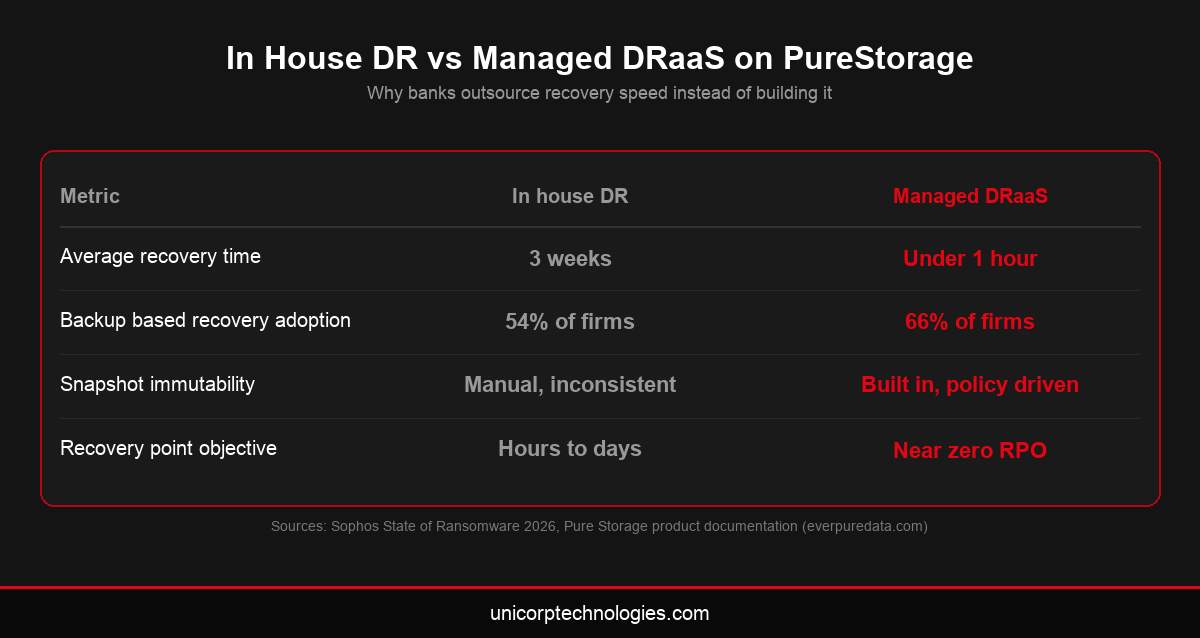
Traditional backup architecture treats snapshots as files that a sufficiently privileged account, including a compromised one, can eventually delete or encrypt. PureStorage's SafeMode snapshots close that gap by making backup data immutable at the storage layer, so ransomware cannot eradicate or modify it even with stolen admin credentials. On the restore side, Pure Storage's FlashBlade architecture delivers rapid restore performance of up to 270 terabytes per hour for production and test workloads, which matters directly for BFSI institutions holding large transaction and customer databases. This combination, snapshots that cannot be destroyed and restore throughput measured in terabytes per hour rather than gigabytes, is what allows DRaaS providers running on PureStorage to commit to recovery windows that a manually rebuilt environment cannot match. The infographic below compares typical in house recovery timelines against managed DRaaS recovery, based on current industry benchmarks.
Sub Hour RTO and RPO: Why BFSI Cannot Accept a Multi Week Rebuild
Sophos' State of Ransomware 2026 report found the average organization still takes about three weeks to recover from a ransomware incident, even as backup based recovery adoption climbed to 66 percent of cases. For BFSI operations, three weeks of degraded service is not a survivable outcome.
Industry data makes the cost of slow recovery concrete. Sophos' 2026 State of Ransomware research found the average recovery time held at three weeks, even though backup based recovery jumped twelve percentage points year over year to 66 percent of encrypted data cases. That gap, more organizations using backups but recovery still taking weeks, shows that having a backup is not the same as having a fast recovery path. BFSI institutions need recovery time objectives measured in minutes or a low number of hours, not weeks, because transaction systems and regulatory reporting cannot pause that long without consequences. Managed DRaaS providers built on immutable, high throughput storage close this gap by pairing tested failover procedures with infrastructure capable of restoring production data quickly once a clean recovery point is confirmed, rather than starting the restore process from scratch after an attack.
The Commercial Case for Outsourcing DR Instead of Building It In House
Building an equivalent in house disaster recovery environment means duplicating infrastructure, staffing specialists to maintain and test it, and absorbing the capital cost even in years when it is never used. DRaaS providers convert that fixed cost into a predictable service agreement, which is the commercial argument BFSI finance teams respond to.
An in house disaster recovery environment requires a bank to buy and maintain a second set of infrastructure that sits mostly idle, staff a team capable of testing failover regularly, and keep both current as production systems change. That cost structure is hard to justify to a finance team, especially when the environment might never be invoked. DRaaS providers convert this fixed capital and staffing cost into an operating expense tied to a service agreement with a defined recovery time objective, part of a broader business continuity solutions strategy that also covers people and process, not just infrastructure. Finance teams evaluating business continuity solutions typically prefer this predictable operating cost over an unpredictable capital request that only gets funded after a near miss. For BFSI institutions, that also shifts testing responsibility to a provider whose business depends on the recovery actually working, rather than an internal team balancing DR testing against other priorities. Unicorp Technologies advises and implements managed disaster recovery services built on platforms like PureStorage for BFSI and enterprise clients across the UAE, scoping the recovery architecture around each institution's transaction volume and regulatory reporting requirements rather than a generic template.
Conclusion
DRaaS providers built on immutable, high throughput storage give BFSI institutions a faster, tested path back to production than most in house recovery environments can match. PureStorage's SafeMode snapshots and rapid restore performance close the gap between backup adoption and actual recovery speed, which industry data shows remains wide. Outsourcing disaster recovery also converts an unpredictable capital cost into a defined service commitment that finance teams can plan around. Unicorp Technologies helps BFSI and enterprise clients across the UAE design and implement this kind of managed recovery architecture. Contact Unicorp to review your current recovery time objectives against what modern DRaaS providers can deliver.
Frequently Asked Questions
What do DRaaS providers actually do differently from a standard backup vendor?

Why is PureStorage relevant to disaster recovery services for banks?
What recovery time objective should a BFSI institution target?
How does immutable storage protect against ransomware specifically?
Is building an in house disaster recovery environment cheaper than using DRaaS providers?
What are business continuity solutions and how do they relate to DRaaS?
How often should a BFSI institution test its disaster recovery plan?
Does cloud backup and recovery alone protect against ransomware?
Can Unicorp Technologies help design a DRaaS strategy for a UAE enterprise?
Where can I learn more about Unicorp Technologies' security and infrastructure services?