Enterprise Data Protection: Why Unified Storage Is the New Cyber Resiliency
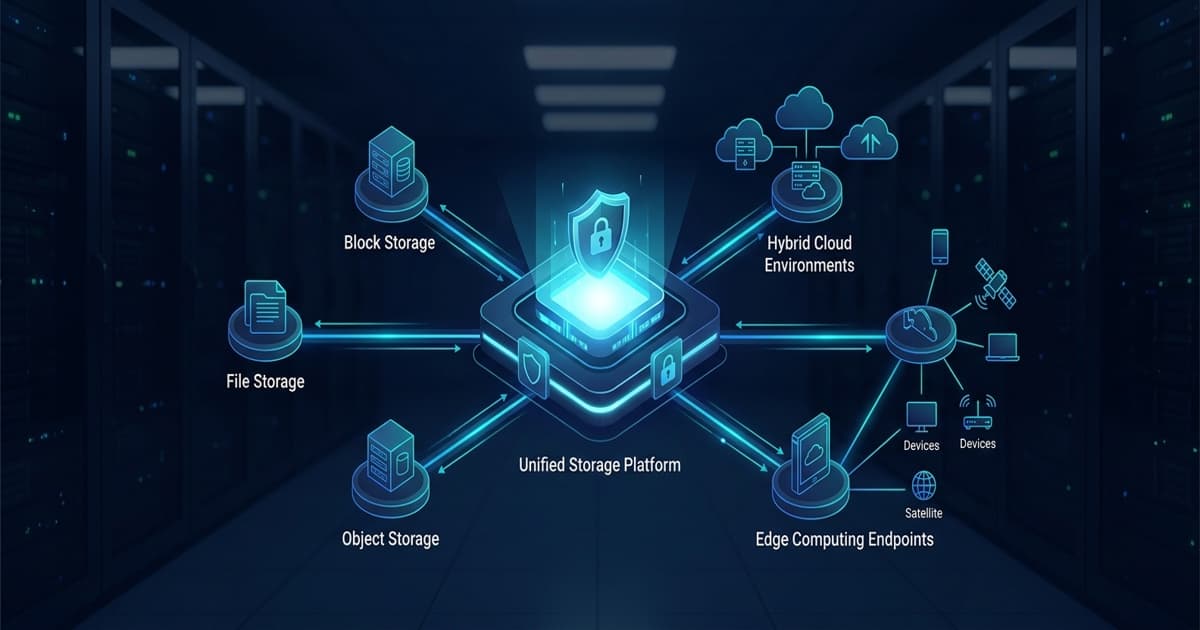
Enterprise data protection has moved far beyond backup schedules and storage capacity planning. Today, every organization faces ransomware attacks targeting backup repositories, hybrid cloud sprawl, AI-driven data growth, and increasingly strict regulatory requirements. Traditional storage architectures, built for performance and availability, are simply not equipped to handle these modern realities. Unified storage has emerged as a strategic imperative, consolidating data protection, recovery, immutability, and security into a single, manageable platform that forms the backbone of true cyber resilience. Unicorp Technologies works with enterprise organizations to design unified storage strategies that address these exact challenges across complex, distributed environments.
Key Takeaways
Enterprise data protection requires unified storage platforms that integrate backup, immutable snapshots, encryption, and rapid recovery into a single architecture capable of withstanding modern ransomware and hybrid cloud threats.
Ransomware now actively targets backup and recovery infrastructure, making immutable storage, cloud workload protection, and tested recovery plans essential defenses for every enterprise organization.
Organizations adopting unified storage reduce operational complexity, accelerate disaster recovery services, and build the resilient data infrastructure needed to support AI workloads and future digital transformation.
The Changing Landscape of Enterprise Data Protection
Enterprise data no longer lives in a single data center. It spans public clouds, private infrastructure, SaaS applications, edge environments, and AI platforms. Managing these through disconnected storage systems creates dangerous visibility gaps and multiplies cyber risk. Organizations need a unified view of their data estate to protect it effectively.
The Rise of Hybrid and Multi-Cloud Environments
Hybrid cloud adoption has fundamentally changed how enterprise data is stored and accessed. Data now flows between on-premises infrastructure and multiple cloud providers simultaneously. This complexity makes consistent policy enforcement, access control, and saas data protection extremely difficult without a unified storage layer. Without centralized visibility, security teams cannot detect anomalies or enforce governance across fragmented environments.
AI and Data-Intensive Workloads
According to IDC research, AI and analytics adoption is significantly accelerating enterprise data growth, increasing demand for unified, scalable, and secure storage platforms. AI workloads require consistent, high-performance access to large datasets. Fragmented storage architectures introduce latency, inconsistent data quality, and increased exposure. Unified storage provides the scalable, policy-driven foundation AI environments demand.
Escalating Ransomware Threats
The Verizon Data Breach Investigations Report consistently identifies ransomware as one of the leading patterns in cyber incidents. Modern ransomware variants specifically target backup systems and recovery infrastructure, not just primary data. This makes traditional backup strategies dangerously inadequate. Organizations without immutable storage and tested recovery plans face extended downtime and potentially catastrophic data loss.
Growing Regulatory and Compliance Demands
Regulatory frameworks across finance, healthcare, and government sectors now require demonstrable data integrity, access controls, audit trails, and tested recovery capabilities. The NIST Cybersecurity Framework 2.0 specifically emphasizes resilient recovery capabilities, data integrity, and governance as core components of enterprise cyber resilience. Disconnected storage systems make compliance reporting time-consuming, error-prone, and difficult to audit.
What Is Unified Storage?
Unified storage is a platform that consolidates block, file, and object storage into a single, centrally managed system. Rather than managing separate silos for different workload types, IT teams gain a consistent control plane for data protection, access, automation, and security across the entire storage estate.
Combining Block, File, and Object Storage
Traditional environments require separate storage systems for databases, file shares, and unstructured data. Unified storage eliminates this fragmentation by supporting all three storage protocols within a single platform. This consolidation reduces hardware footprint, simplifies licensing, and ensures consistent data loss prevention policies are applied across every data type and workload without exception.
Centralized Management and Automation
A unified storage platform delivers a single management interface for provisioning, monitoring, tiering, and policy enforcement. Automation capabilities reduce manual administrative tasks, minimize configuration errors, and accelerate response to storage events. IT teams can enforce consistent data protection policies at scale, improving both security posture and operational efficiency across distributed environments.
Built-in Data Protection Capabilities
Modern unified storage platforms embed data protection directly into the architecture. This includes immutable snapshots, continuous replication, automated backup scheduling, encryption at rest and in transit, and anomaly detection. These capabilities transform storage from a passive infrastructure component into an active defense layer within the enterprise security stack.
Scalability for Modern Enterprise Workloads
Unified storage platforms are designed to scale horizontally as data volumes grow. Whether driven by AI pipelines, cloud-native applications, or regulatory retention requirements, the platform expands without requiring architectural redesign. This future-proof scalability ensures that enterprise data protection capabilities keep pace with business growth rather than becoming a constraint on it.
Why Unified Storage Strengthens Cyber Resilience
Cyber resilience is the ability to anticipate, withstand, recover from, and adapt to adverse cyber events. Storage is the foundation upon which this capability is built. Organizations that align their storage strategy with cyber resilience objectives gain measurable advantages in recovery speed, data integrity, and business continuity.
Immutable Snapshots and Backup Protection
The U.S. Cybersecurity and Infrastructure Security Agency (CISA) recommends immutable backups, offline recovery, and tested recovery plans as essential defenses against ransomware. Immutable snapshots prevent data from being altered or deleted, even by privileged users or malware. This protection layer is critical for ensuring that a clean, recoverable copy of data is always available following an attack.
Rapid Recovery After Ransomware Attacks
Recovery time directly impacts business continuity and financial exposure. According to the IBM Cost of a Data Breach Report, organizations with mature incident response and recovery capabilities experience significantly lower breach costs and faster recovery times. Unified storage with automated failover and granular snapshot recovery dramatically reduces recovery time objectives (RTOs) and recovery point objectives (RPOs) compared to traditional approaches.
Continuous Data Availability
Data centre resilience solutions built on unified storage platforms support continuous data availability through synchronous replication, automatic failover, and self-healing storage architectures. High availability features ensure that workloads remain accessible even during hardware failures, regional outages, or active security incidents. Continuous availability reduces operational disruption and protects revenue-generating systems from unplanned downtime.
Simplified Disaster Recovery
Unified storage simplifies disaster recovery services by integrating recovery workflows directly into the storage platform. Rather than orchestrating separate backup, replication, and recovery tools, IT teams manage the entire DR lifecycle from a single interface. This simplification reduces recovery complexity, eliminates tool sprawl, and ensures that DR processes align with validated recovery objectives across all workload types.
Integrated Security Features
Gartner highlights cyber storage, ransomware resilience, and integrated storage security as strategic priorities for modern infrastructure leaders. Unified platforms incorporate role-based access control, multi-factor authentication, end-to-end encryption, and behavioral anomaly detection at the storage layer. These integrated security features reduce the attack surface and provide an additional defensive barrier that complements network and endpoint security controls.
Five Business Benefits of Unified Storage
Reduced Infrastructure Complexity
Consolidating disparate storage systems into a unified platform eliminates silos, reduces vendor management overhead, and simplifies the overall infrastructure architecture. Fewer systems mean fewer configuration inconsistencies, fewer potential failure points, and faster troubleshooting. IT teams spend less time managing storage complexity and more time on strategic security and innovation initiatives that drive measurable business value.
Lower Total Cost of Ownership
Unified storage reduces hardware acquisition costs, licensing fees, and operational overhead associated with managing multiple point solutions. Automated tiering moves data to the most cost-effective storage tier based on access patterns, further optimizing expenditure. Organizations typically achieve measurable reductions in total cost of ownership while simultaneously improving their enterprise data protection capabilities and resilience posture.
Improved Operational Efficiency
Centralized management, automated policies, and integrated monitoring enable IT teams to operate storage environments more efficiently. Routine tasks such as snapshot scheduling, capacity management, and compliance reporting are automated, freeing skilled staff for higher-value activities. Operational efficiency gains also translate into faster incident response times during security events.
Enhanced Compliance Readiness
Unified storage platforms provide comprehensive audit trails, access logs, and policy enforcement records that simplify regulatory compliance reporting. Whether meeting requirements under data protection regulations or industry-specific frameworks, organizations can demonstrate data integrity and control with confidence. Centralized governance also makes it easier to respond to audit requests quickly and accurately.
Future-Proof Support for AI and Analytics
As AI and analytics workloads grow, storage must deliver consistent performance, low latency, and intelligent data management. Unified storage platforms with AI-driven analytics and automated tiering are purpose-built to support these requirements. Organizations that invest in modern unified storage today are establishing the data infrastructure foundation necessary for competitive AI adoption tomorrow.
Key Features to Look for in a Unified Storage Platform
When evaluating unified storage solutions for enterprise resilience, prioritize platforms that include the following capabilities:
Immutable storage with write-once, read-many protection for backup data
Built-in ransomware detection using behavioral analytics and anomaly alerts
Snapshot management with granular, automated, and policy-driven capabilities
Encryption at rest and in transit using current cryptographic standards
Hybrid cloud integration for seamless hybrid cloud disaster recovery across on-premises and cloud environments
AI-driven storage analytics for capacity planning, performance optimization, and predictive health monitoring
Automated tiering to optimize cost across performance and capacity tiers
High availability with synchronous replication and automatic failover capabilities
Centralized policy management for consistent governance across all workload types
Best Practices for Modern Enterprise Data Protection
Adopt a Zero Trust Data Strategy
Zero Trust principles apply directly to storage environments. Every user, application, and workload requesting storage access should be verified, authorized, and continuously monitored. Implementing least-privilege access policies, micro-segmentation, and multi-factor authentication at the storage layer eliminates implicit trust and significantly reduces insider threat and lateral movement risk.
Implement the 3-2-1-1-0 Backup Rule
The 3-2-1-1-0 backup strategy extends the traditional 3-2-1 rule by adding one immutable or offline copy and verifying zero errors in recovery testing. Maintain three copies of data, on two different media types, with one copy offsite, one copy immutable or air-gapped, and zero unverified backups. This strategy ensures that at least one clean, recoverable copy survives even a sophisticated ransomware attack targeting backup infrastructure.
Regularly Test Recovery Processes
An untested recovery plan is not a recovery plan. Organizations should conduct regular, documented recovery drills that simulate realistic ransomware and outage scenarios. Testing validates RTOs and RPOs, identifies gaps in recovery workflows, and builds organizational confidence in the ability to restore operations quickly. CISA recommends tested recovery as a foundational ransomware defense.
Monitor Storage Health Continuously
Proactive storage health monitoring detects capacity issues, performance degradation, and security anomalies before they escalate into incidents. AI-driven monitoring tools analyze storage telemetry in real time, flagging unusual access patterns or data modification behaviors that may indicate a ransomware infection or insider threat. Continuous monitoring is a prerequisite for effective data centre resilience solutions.
Align Storage with Business Continuity Planning
Storage strategy must be explicitly integrated into the broader business continuity plan. Recovery objectives for critical workloads should define storage architecture decisions, replication configurations, and failover priorities. When storage and business continuity planning are aligned, organizations can recover mission-critical systems faster and with greater confidence during actual disruption events.
The Future of Enterprise Storage
The evolution of enterprise storage is accelerating. Several emerging trends will shape how organizations approach enterprise data protection in the coming years.
AI-powered storage management will automate capacity planning, performance optimization, and anomaly detection with minimal human intervention. Autonomous storage operations will enable self-healing, self-optimizing storage platforms that adapt in real time to changing workload demands. Cyber storage vaults, isolated and immutable recovery environments, will become a standard component of ransomware resilience architecture.
Intelligent data classification will automate the tagging, tiering, and protection of data based on business value and regulatory requirements. Unified storage for edge computing will extend consistent governance and protection policies to distributed edge environments. Finally, quantum-safe encryption readiness will become a critical consideration as post-quantum cryptographic standards are finalized and adopted across regulated industries.
Organizations that begin modernizing their storage infrastructure today will be far better positioned to adopt these capabilities without disruptive architectural overhauls in the future. To understand how these emerging capabilities apply to your organization's specific environment, contact the Unicorp Technologies team to begin a structured storage modernization assessment.
Conclusion: Storage Is the Foundation of Cyber Resilience
Enterprise data protection is no longer a function of backup alone. It requires a unified, security-integrated storage architecture capable of withstanding ransomware, supporting rapid recovery, and enabling business continuity across hybrid and multi-cloud environments. Organizations that modernize their storage infrastructure position themselves to reduce breach impact, accelerate recovery, and meet the demands of AI-driven digital transformation. Explore how Unicorp Technologies leadership approaches enterprise resilience strategy, and reach out through our contact page to design a future-ready enterprise data protection strategy built on unified, resilient storage foundations that protect your most critical assets today and tomorrow.
Frequently Asked Questions
What is unified storage and how does it differ from traditional storage?

How does unified storage improve enterprise data protection?
Why is unified storage important for cyber resilience?
What is immutable storage and why does it matter for ransomware defense?
How does unified storage help defend against ransomware attacks?
What are the key benefits of consolidating enterprise storage?
How does unified storage support hybrid cloud disaster recovery?
What is the 3-2-1-1-0 backup strategy and why should enterprises adopt it?
How can organizations improve disaster recovery using unified storage platforms?
Why is storage modernization essential for enterprise digital transformation?