Privileged Identity Management for Government Entities: Closing the Insider Access Gap

Privileged identity management is the difference between a government IT team that can prove who touched a citizen record and one that cannot. Admin and service accounts inside government entities carry access far beyond what most staff use day to day, which makes them the highest value target for insider misuse and external compromise alike. Over provisioned access, shared credentials and missing session records turn a routine audit into a scramble. This guide focuses on how government entities close that insider access gap using just in time elevation, session recording and credential vaulting.
Key Takeaways
Privileged accounts are a small share of total user accounts but are involved in most serious government data incidents, which is why privileged identity management deserves separate attention from general identity and access management. Just in time access replaces standing admin rights with time boxed elevation, so an account only holds privileged access for the duration of an approved task. UAE government audit requirements increasingly expect session recording and credential vaulting as evidence, not a policy document that only describes least privilege in theory.
Government procurement for privileged identity management should weigh data residency and legacy system integration alongside features, since a platform that cannot host session data in country rarely clears a government vendor review.
Government Admin Accounts Are the Highest Value Target in the Building
A government entity's most sensitive systems, citizen records, procurement platforms, licensing databases, are usually reachable by a small number of admin accounts. Attackers and malicious insiders both know this. Privileged identity management exists because these accounts carry more damage potential per compromise than any other account type in a government network.
Most government IT environments run hundreds or thousands of standard user accounts and a much smaller set of privileged accounts, the domain admins, database administrators and service accounts that can read, modify or export sensitive records. That small set carries disproportionate risk. A compromised standard account usually exposes one person's access. A compromised privileged account can expose an entire citizen database, procurement system or licensing platform. Insider risk compounds this further. Staff with legitimate admin rights sometimes retain access long after their role changes, or share credentials informally to get urgent work done faster. Neither scenario shows up in a typical access review unless someone is specifically looking for it. Privileged identity management treats these accounts as a distinct risk category, with tighter controls, shorter access windows and mandatory logging, instead of applying the same policy used for a general staff account. Unicorp Technologies has written previously about why privileged identity management is critical to PAM strategies and about extended privileged access management approaches; this piece focuses specifically on how privileged identity management applies to government audit and insider access requirements rather than repeating that general PAM foundation.
Why Standing Privileged Access Fails UAE Government Audit Requirements
Standing access, where an admin account keeps elevated rights permanently, is the pattern most UAE government audits flag first. A government entity that cannot show why an account held elevated access on a given date struggles to demonstrate compliance, regardless of how strong its password policy looks on paper.
UAE Information Assurance Standards place identity and access management among their priority controls, requiring role based access, monitoring of privileged accounts and regular access reviews, consistent with the NIST's SP 800-53 access control guidance that many government security teams also reference for least privilege. Standing privileged access, where an account retains admin rights indefinitely rather than for a specific task, is difficult to defend during a review, and it is the single most common finding in a privileged identity management readiness assessment. An auditor asking why a service account has held database administrator rights for eighteen months, with no record of what it was used for, exposes a gap that a policy document alone cannot close. Government entities under this scrutiny need evidence, not intent. That evidence comes from access logs tied to specific requests, approvals and time windows, which is exactly what standing access does not produce. Reducing standing privilege is the single change that most improves a government entity's audit posture without requiring new hardware or a platform migration.
Just in Time Access: Replacing Standing Privilege With Time Boxed Elevation
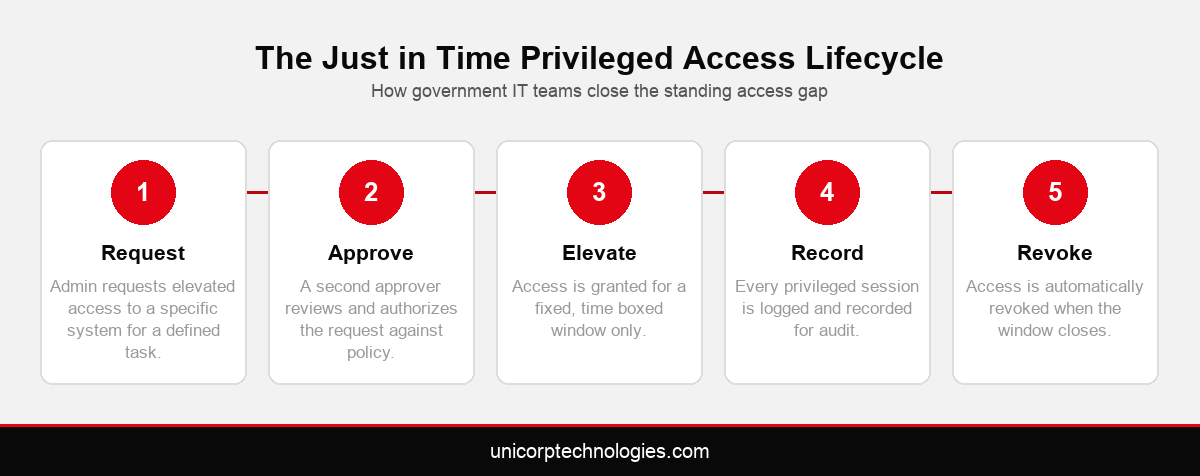
Just in time privileged access grants elevation only for the duration of an approved task, then revokes it automatically. Instead of an admin account holding permanent rights, the account requests access, a second approver authorizes it, and the system logs and revokes the session without manual follow up.
Just in time access changes the default state of a privileged account from elevated to standard. When an administrator needs to patch a licensing database or investigate an incident on a citizen facing system, they submit a request describing the task. A second approver reviews that request against policy before granting access, and the elevation is scoped to a fixed time window rather than left open ended. Every action inside that window is logged for audit, and access reverts automatically once the window closes, without requiring the admin or a supervisor to remember to revoke it manually. This lifecycle, request, approve, elevate, record, revoke, replaces a static access list with a chain of accountable decisions. It also reduces the standing attack surface that zero trust remote access policies are designed to shrink, since a dormant privileged account with no active task has nothing to compromise. The infographic below maps this lifecycle as government IT teams typically implement it.
 jit-privileged-access-lifecycle.png
Session Recording and Credential Vaulting: Closing the Insider Visibility Gap
Just in time access controls when elevation happens. Session recording and credential vaulting control what happens during that window. Together they remove the two blind spots that let insider misuse go undetected in government networks: unmonitored sessions and shared, unmanaged credentials.
Time boxing an elevated session does not, by itself, show what an administrator did while inside a sensitive system. Session recording closes that gap by capturing commands, screens or database queries executed during a privileged session, giving investigators a record to review if something looks wrong later. Credential vaulting solves a related problem: shared admin passwords passed between staff informally, often never rotated, are a common insider risk in government IT teams under staffing pressure. A credential vault stores privileged passwords centrally, rotates them automatically after each use, and checks them out only for an approved, time boxed session rather than leaving them memorized or written down. Combined, session recording and credential vaulting mean a government entity can answer the question every audit eventually asks: who did what, when, and under whose approval. This pairing is also what separates a mature privileged identity management program from network security companies that only sell perimeter tools without addressing the identity layer behind them, and it gives zero trust remote access policies something concrete to enforce beyond a login prompt.
Procuring Privileged Identity Management for a Government Entity
Government procurement adds requirements a standard commercial identity and access management rollout does not face, including data residency, vendor vetting and integration with legacy systems that cannot simply be replaced. Unicorp Technologies advises government clients through this process rather than proposing a one size fits all platform.
Government entities procuring privileged identity management need to weigh more than feature lists. Data residency matters because session recordings and credential vaults often need to stay within UAE jurisdiction to satisfy data sovereignty expectations tied to UAE's national cybersecurity strategy. Integration matters because most government IT environments run a mix of legacy systems that predate modern identity platforms, alongside newer cloud services, and a rollout has to bridge both without disrupting services citizens rely on daily. Secure remote access solutions for government staff also need to route through the same privileged identity management controls, not a separate, disconnected remote access tool. Unicorp Technologies works with government entities across Abu Dhabi and Dubai to scope this kind of rollout, starting with the highest risk privileged accounts identified during a readiness assessment rather than attempting a single, disruptive migration. Government teams can review Unicorp's broader identity and access management capabilities alongside the rest of its cyber security portfolio, including secure remote access solutions built to work with a government entity's privileged identity management controls rather than around them.
Conclusion
Privileged identity management closes the insider access gap that standing admin rights, shared credentials and unmonitored sessions leave open in government IT environments. Just in time elevation, session recording and credential vaulting give government entities the audit evidence that policy documents alone cannot provide. This is not a general identity project, it is a targeted response to the accounts that carry the most risk in a government network. Unicorp Technologies helps government entities across the UAE scope and implement this approach around real legacy systems and data residency requirements. Contact Unicorp to assess your privileged account exposure.