Privileged Identity Management Services UAE: Dubai Guide

Most privileged access programmes are built around employees, yet some of the most powerful accounts in a Dubai enterprise belong to people who are not on the payroll. Outsourced IT teams, software vendors and contractors routinely hold administrator rights. When you evaluate privileged identity management services UAE providers offer, that external group is the hardest test of the service. This guide sets out what the service should cover, which controls to require for outside staff, and how to compare providers using evidence from a working trial.
Key Takeaways
- Judge a provider on how it handles external administrators, because contractor access is where ordinary controls most often fail.
- Require time-bound elevation, separate approval, session records and removal tied to the contract end date.
- Run a proof of concept on one real contractor group instead of relying on a scripted demonstration.
Why Contractors Change the Requirement
Employee access has natural checkpoints. HR records a joiner, a manager approves a role, and a resignation triggers removal. External staff often skip all of this. A vendor engineer may be added for a two week project through a ticket, using an account nobody later reviews.
Dubai's operating model makes this common. As eMudhra observes, UAE businesses rely heavily on outsourced contractors in sectors including retail, construction and IT, and it recommends temporary credentials with restrictions by device, location or time. Allow for the fact that eMudhra sells identity products, but the pattern will be familiar to most IT directors.
The risk is about accumulation as much as bad intent. Over several years, a firm collects accounts belonging to former suppliers, shared logins handed between shifts and service accounts tied to a person who has moved on. Each one is a route into critical systems that nobody is watching.
Our earlier piece on closing the insider access gap looks at this problem inside government entities. A contractor raises a different question, because you cannot enrol that person in your HR process or rely on your line management to notice a change.
Remote administration widens the gap. Support tools, jump hosts and vendor portals can create paths into production that sit outside your standard login route. Many remote work security solutions secure the connection well and still say little about what an administrator did once connected.
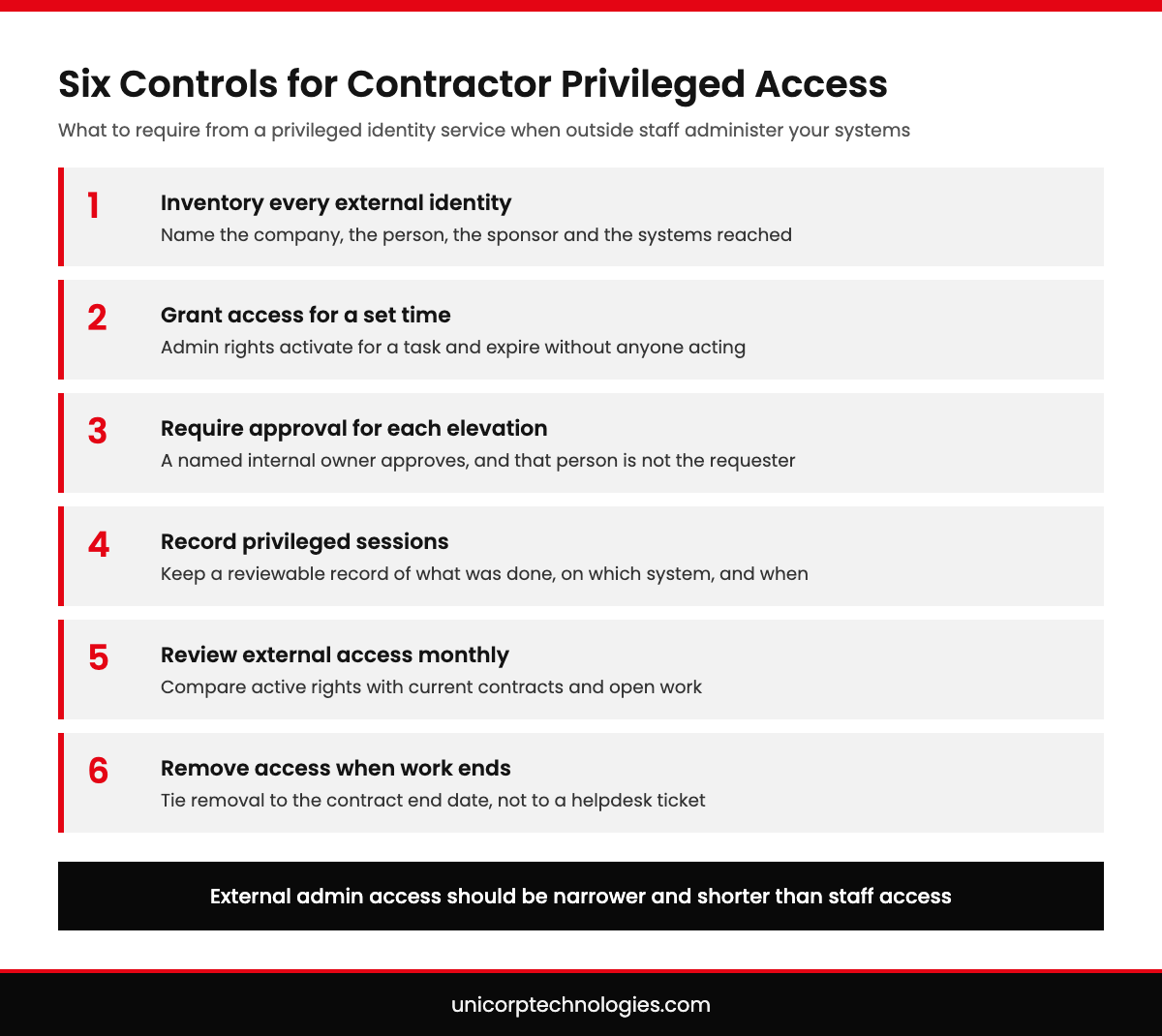
Extended roles add to the picture. Our note on extended privileged access in modern environments covers service identities and machine access, which often sit in the same blind spot. Start by writing the inventory. For each external identity, record the company, the individual, the internal sponsor, the systems reached and the contract end date. Blank fields in that list are your first findings, and they often make the business case for the whole project.
What Privileged Identity Management Services UAE Buyers Should Require
Discovery. The service should find privileged accounts across directories, cloud platforms, servers and key applications, including local and shared accounts. Ask how it finds accounts that were created outside the normal process, since those matter most.
Time-bound elevation. Administrators should hold standard rights by default and activate higher rights for a stated task and period. Access then expires without anyone acting. This follows the principle of least privilege in NIST SP 800-53, which is a useful reference when writing requirements.
Separate approval. The person requesting elevated rights should not approve them. NIST's separation of duties control sets out the same idea. For external staff, the approver should be a named internal owner of the system, not the supplier's own team lead.
Session records. For sensitive systems, you should be able to see what a privileged user did, on which system and when. Take legal advice on consent and privacy, write the recording into contracts, and restrict who may view the records.
Account lifecycle. Account management is the least glamorous control and among the most valuable. Removal should link to the contract end date, and an account with no current sponsor should be suspended automatically.
Reporting. You need an exportable record of who held which role, who approved it and when it ended. Dubai government entities under the Dubai Electronic Security Center's Information Security Regulation should check how those records support their own compliance work. Other firms should check them against internal audit needs.
Running External Access Reviews That Mean Something
Many access reviews fail because they ask a manager to approve a long list of accounts they do not recognise. Everything gets approved, and the audit file looks complete. External access deserves a shorter, sharper process.
Review less, more often. Start with Identity's practice guide recommends quarterly reviews for third-party identities and monthly reviews for privileged external accounts. It also advises routing administrative sessions from managed service providers through a privileged access management solution.
Give each reviewer the facts needed to decide: the contract end date, the last activity date, recent elevations and the systems reached. A sponsor can answer quickly when the question is whether this engineer still needs production access for the migration that finished in August.
Compare access with contracts directly. Ask procurement for the list of active suppliers, then match it to the external accounts. Accounts belonging to suppliers who no longer appear should be disabled and investigated.
Watch for shared accounts. They break the link between an action and a person, so they weaken every other control on this list. Replace them with named identities where possible. Where a legacy system prevents this, vault the credential and record who checked it out.
Comparing Providers in Dubai
Most cyber security companies in Dubai will show a capable platform in a demonstration. The differences appear in delivery. Decide first whether you need a product, an implementation partner or a managed service, because technology security companies price and staff these very differently.
Ask who operates the service after go-live. Someone must handle elevation requests at night, tune policies and investigate unusual sessions. If that work stays with your team, count the effort. If a provider takes it on, remember that the provider itself now holds privileged access, and put it through the same controls.
Run a proof of concept with evidence. Onboard one real contractor group on one critical platform. Grant a time-bound role, require approval, record a session, remove the access on a set date and then export the audit trail. A good cyber security consultant will welcome this test, because it reveals integration problems early.
Check the awkward systems. Ask how the service handles legacy applications, network devices, operational technology and SaaS administrator roles. Coverage gaps here tend to become permanent exceptions.
Clarify support and data handling. Confirm response times, where session records are stored, who can reach them and what happens to them when the contract ends. These answers matter as much as the feature list when the records contain sensitive administrative activity.
Check that the service works across your locations too. A group with data centres or teams in Dubai and Abu Dhabi needs one consistent policy, a clear record of which administrator reached which site, and approvers who are actually available in each location during working hours and out of hours. Local presence helps here, because onboarding contractors, testing break glass access and investigating an unusual session are easier when the provider can sit down with your team.
Budget for the work around the platform as well. Licences are usually the visible cost, yet discovery, application onboarding, policy design and ongoing review consume most of the effort in the first year. Ask each provider to price those separately, so you can compare like with like and see what remains with your own staff after go-live.
Plan for the failure case too. If the privileged access service is down during an outage, your administrators still need a way in. Agree how emergency access works, who can use it, how it is recorded and how the credentials are changed afterwards. Test that route before you rely on it, and include external support staff in the exercise.
Finally, ask for a phased plan built on your inventory. A credible plan starts with the highest risk platforms and external parties, sets a date for removing standing rights, and names the owner of each exception.
Conclusion
The best test of privileged identity management services UAE providers offer is how they treat people outside your organisation. Build an external identity inventory, require time-bound elevation and separate approval, keep usable records, and tie removal to the contract. Then prove it on one real contractor group before committing to a wider rollout. If you would like help scoping that trial, speak with Unicorp's identity and access team, or contact our Dubai or Abu Dhabi office to arrange a privileged access review.
Frequently Asked Questions
What do privileged identity management services UAE firms buy actually include?

How is privileged identity management different from privileged access management?
Why are contractors a particular privileged access risk?
How often should external privileged access be reviewed?
Should contractor sessions be recorded?
Does this apply to remote support providers?
What should a Dubai buyer ask in a proof of concept?
How long does a first phase take?
How can Unicorp help?