Remote Workforce Data Protection: A Zero Trust Blueprint for Government Teams

Public sector work no longer happens in one building, and the data it produces no longer stays in one. Case files are reviewed from home, inspections are recorded on tablets in the field, and shared documents move between authorities on a daily basis. Remote workforce data protection is the set of controls that lets that happen without the data quietly accumulating on devices and accounts nobody governs. What makes it difficult in government is not the technology; it is that the classification obligations are stricter, the user population is more varied, and the evidence requirements are higher than in most commercial estates. This blueprint sets out the four control layers, what each produces as evidence, and how to sequence them. Our note on protecting UAE hybrid teams with zero trust services covers the operational side.
Key Takeaways
- Four layers carry the load: identity, device, data and network. Each answers a different question, and a gap in any one of them undermines the other three.
- Data-layer controls are the only ones that keep working after a file leaves your platforms, which is why classification and rights management are load-bearing rather than optional.
- Design every control around what a busy officer will do when it fires at an inconvenient moment, because the workaround is always a personal device and a personal account.
The Four Layers and What Each Answers
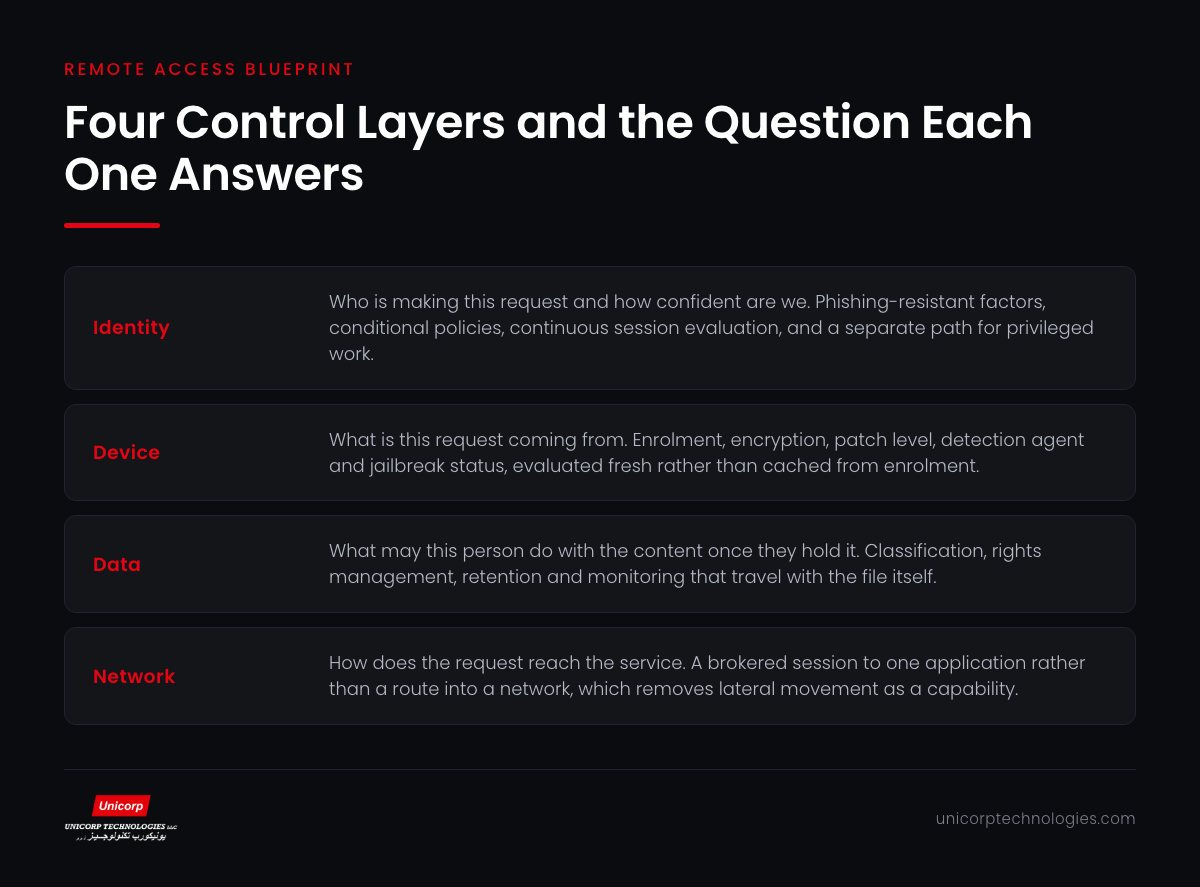
The identity layer answers who is making this request, and how confident are we. It covers authentication strength, session lifetime, conditional policies and the joiner, mover and leaver processes that decide what an account holds in the first place.
The device layer answers what is this request coming from. Enrolment, encryption, patch level, endpoint detection and jailbreak status together describe the machine rather than the person, and in a distributed estate that is the signal that distinguishes a legitimate session from a stolen credential used elsewhere.
The data layer answers what may this person do with this content once they have it. Classification, rights management, retention and monitoring travel with the file, which is what makes them the only controls that still apply after a document is downloaded to an unmanaged device.
The network layer answers how does this request reach the service. In a zero trust design this is the thinnest layer, brokering a session to one application rather than granting a route into a network, which removes lateral movement as a capability instead of trying to detect it.
Effective remote workforce data protection needs all four. Identity without device posture accepts stolen credentials from unknown machines. Device without data controls protects the endpoint and not the file. Data without network brokering leaves lateral paths open. The reference model in NIST SP 800-207 describes how the layers combine into a single decision.
Identity: Making the First Decision Trustworthy
Phishing-resistant authentication should be the default for anyone touching classified material and mandatory for privileged roles. Standard second factors are still valuable and are now routinely defeated by token theft and consent phishing, which succeed against accounts that completed a valid challenge. Our note on why identity controls cannot rely on MFA alone covers the specific techniques.
Conditional access policies should evaluate the whole context rather than the credential alone: device compliance, location plausibility, session risk and the sensitivity of what is being requested. The policy set needs to be small enough that someone can explain it, because policy sets that grow past twenty rules develop contradictions nobody notices until an access failure is investigated.
Session lifetime deserves explicit thought in a government context. Long sessions are convenient for field staff with intermittent connectivity and dangerous on shared or personal devices. Continuous evaluation, where a revoked account loses access within minutes rather than at token expiry, resolves most of the tension.
Joiner, mover and leaver processes carry unusual weight in the public sector because secondments and temporary assignments are frequent. Access that follows a person into a new role without shedding the previous permissions accumulates into standing privilege that no periodic review reliably catches.
Privileged access should never share the ordinary remote path. Administrative work belongs on managed workstations with higher posture requirements, through a brokered session that records activity, with credentials that exist only for the task in hand.
Device: The Signal That Describes the Machine
Posture must be verified rather than declared, and it must be fresh. A compliance check performed at enrolment and cached for a month tells you what the device looked like then, which is not a control. Signals older than a defined threshold, usually measured in hours, should be treated as unknown posture rather than as a pass.
The response to failed posture should be graduated. Full access when healthy, read-only browser access when degraded, and a self-service remediation path that names exactly what the user must fix. Hard blocks push people onto personal devices, which converts a manageable degraded session into an ungoverned one.
Unmanaged devices need a defined lane. Browser-only access with no local download, no clipboard export and no offline cache lets an officer read a document on a personal tablet without the file ever landing on unmanaged storage. Platform-specific baselines such as the NCSC device security guidance are worth adopting rather than writing from scratch.
Field devices deserve their own profile. Tablets used for inspections operate offline, are handled in public, and are lost more often than office laptops. Shorter lock timers, remote wipe tested rather than assumed, and offline data limited to the current assignment are the practical controls, and they should be configured as a distinct profile rather than as exceptions to the office one.
Data: Controls That Travel With the File
The data layer is where remote workforce data protection either holds or fails, and classification has to be simple enough to apply correctly under time pressure. Three or four tiers, applied at creation with a sensible default, supported by automatic detection for recognisable content such as identity numbers and case references. Elaborate taxonomies produce inconsistent labels, and inconsistent labels create false confidence, which is worse than none.
Rights management enforces what each label permits and continues to apply after the file leaves your platforms. Which groups may open it, whether it can be printed or forwarded, and whether access expires on a date. This is the control that still works when a document reaches a personal mail account or a removable drive.
External sharing configuration is where most accidental exposure originates in public sector estates, because authorities share constantly with consultants, contractors and each other. Default settings in collaboration platforms are permissive, and tightening them with explicit rules per classification tier is a short project with a large effect.
Monitoring should follow the data rather than the device. Alerts on bulk download, on classified content moving to unmanaged storage, and on sharing links created for external addresses catch the realistic failure modes far more reliably than endpoint telemetry alone.
Retention and disposal complete the layer and are frequently forgotten. Content that should have been disposed of years ago is still exposure, and in the public sector it is also a records management obligation. Retention schedules should be implemented in the platform rather than left as a policy statement.
Network: Brokering Instead of Routing
The network layer should be the last thing you change and the thinnest thing you keep. Identity, device and data controls have to be working before removing network-level access is safe, because in most estates the network boundary is currently compensating for their absence.
The target pattern is application brokering. A user requests one application, the broker evaluates identity, posture and policy, and connects that session to that application alone. No network route is issued, so lateral movement stops being a detection problem and becomes an unavailable capability.
Migrate application by application, starting with those already delivered over the web with clean authentication. Each migration removes a group of users from the legacy remote access path, and the remaining population shrinks toward the small set of systems that genuinely need network-level connectivity.
Legacy and thick-client applications need a plan rather than a permanent exception. Connector-based publishing fronts most internal web applications without modification, and desktop delivery handles most of the rest. What should not survive is an open-ended remote access service kept alive for a handful of systems nobody has scheduled.
Our note on closing the insider access gap for government entities covers the privileged path that sits alongside this.
Sequencing, Evidence and Adoption
Deliver remote workforce data protection in four phases, in the order the layers were described: identity, device, data, network. Each phase should deliver evidence as well as capability, because in a public sector estate the evidence is what a review will ask for and assembling it later is considerably harder.
The evidence pack should contain enrolment and compliance rates by device class, an inventory of conditional access policies with the conditions each evaluates, classification coverage across document stores, external sharing configuration per tier, and migration status against the remaining legacy access population.
Expect the review to focus on exceptions rather than on design. Which users are exempt from posture requirements and why, how many unmanaged devices exist and what they can reach, and which applications still require network-level access. Exceptions that are enumerated, owned and time-bound are acceptable; exceptions discovered during the review are findings.
Adoption is the risk that decides whether any of this works. A control that makes legitimate work harder produces a workaround within a week, and in government that workaround is usually a personal device and a personal email account. Test each control against the question of what a busy officer does when it fires at an inconvenient moment, and build the graduated path before the block.
If you are building or reviewing this blueprint for your entity, our team can assess the current layers with you and identify which decisions points are missing. You can also see how our security practice supports public sector estates across identity, endpoint and data controls.
Frequently Asked Questions
Which of the four layers matters most?

Why is device posture more important than location?
How fresh do posture signals need to be?
What should happen when a device fails posture checks?
How many classification tiers should we use?
Do field devices need a different configuration?
When should we replace the VPN?
What evidence will a review ask for?
How do we stop staff working around the controls?