Secure Remote Access Solutions: Meeting Modern UAE Mandates
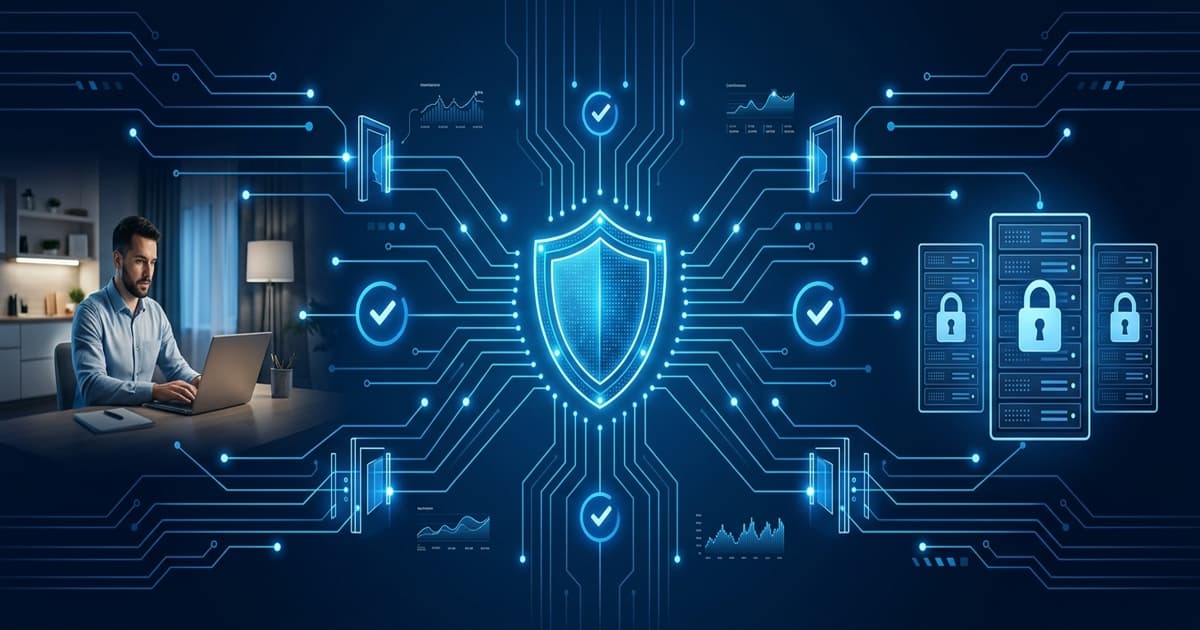
Secure remote access solutions have become a critical pillar of enterprise cybersecurity in the UAE. As hybrid work models become permanent and cloud adoption accelerates, the attack surface for organizations has expanded far beyond traditional network perimeters. Cybercriminals now exploit VPN vulnerabilities, stolen credentials, and compromised endpoints to breach enterprise systems. Organizations that rely solely on legacy remote access tools are operating with a dangerous blind spot.
Key Takeaways
Secure remote access solutions built on Zero Trust architecture provide stronger protection than legacy VPN models by verifying identity and device posture continuously throughout every session.
Zero trust remote access enforces least-privilege policies and application-level controls, reducing the risk of lateral movement and credential-based attacks across the enterprise.
Modernizing remote access today positions UAE organizations for better resilience, regulatory alignment, and seamless hybrid workforce enablement as digital transformation accelerates.
Why Remote Access Security Has Changed
The shift to distributed work has fundamentally altered how enterprise resources are accessed. Remote access is no longer a convenience feature reserved for traveling executives. It is the primary way millions of employees, contractors, and partners interact with critical business systems every single day. Understanding these changes is essential for any organization evaluating modern network security solutions that go beyond simple perimeter defense.
Hybrid and Remote Work
Hybrid work is now a permanent operating model for most UAE enterprises. Employees connect from home networks, co-working spaces, and mobile devices. Each connection point represents a potential entry vector for attackers. Without identity-aware controls and continuous monitoring, organizations cannot distinguish between a legitimate employee and an attacker using stolen credentials from an unmanaged device. Investing in proven enterprise cybersecurity services is essential for managing this expanded access landscape. Contact our security specialists to evaluate your current hybrid workforce access posture.
Cloud-First Business Applications
Modern enterprises run core operations on cloud-hosted platforms such as ERP systems, CRM tools, and productivity suites. Traditional VPNs were designed to connect users to on-premises infrastructure, not cloud applications. Routing cloud traffic through a centralized VPN gateway introduces latency, reduces performance, and creates bottlenecks that frustrate users without meaningfully improving security.
Third-Party Vendor Access
Contractors, vendors, and partners regularly require access to enterprise systems. Managing third-party remote access through shared VPN credentials is inherently risky. Organizations often lack the granular controls to limit what external users can see and do, creating an over-privileged access environment that attackers can exploit. Purpose-built network security solutions can enforce precise access boundaries for every external user while maintaining full auditability of all third-party sessions.
Identity-Based Cyberattacks
The Microsoft Digital Defense Report identifies identity compromise and credential theft as leading attack methods targeting enterprises globally. Phishing campaigns, password spraying, and credential stuffing attacks specifically target remote access entry points. Once an attacker obtains valid credentials, a traditional VPN provides virtually no barrier to lateral movement across the network.
Growing Regulatory Expectations
The UAE Cybersecurity Council actively promotes cyber resilience, secure digital transformation, and critical infrastructure protection across sectors. Enterprises in finance, healthcare, and government are expected to implement modern access controls that align with national cybersecurity initiatives. Organizations must treat remote access governance as a regulatory and business continuity responsibility, not merely a technical configuration task. The Unicorp Technologies leadership team has deep expertise helping UAE organizations navigate these evolving regulatory expectations.
What Are Secure Remote Access Solutions?
Modern secure remote access solutions move beyond simple network tunneling. They integrate identity verification, device trust, and application-level controls into a unified access framework designed around the principle of 'never trust, always verify.'
Core components of modern secure remote access include:
Zero Trust Network Access (ZTNA): Grants access based on verified identity and device posture rather than network location.
Identity-aware access: Evaluates user identity through strong authentication before granting any resource access.
Context-based authentication: Considers factors such as location, device health, time of access, and behavioral patterns.
Device posture validation: Confirms that connecting devices meet security standards before granting access.
Least-privilege access: Limits user permissions to only what is necessary for their specific role.
Continuous verification: Monitors sessions in real time and revokes access when risk signals are detected.
According to NIST Special Publication 800-207, Zero Trust Architecture recommends continuous verification, least-privilege access, and identity-centric security as the foundation for modern enterprise access models. These principles are directly applicable to remote access architectures operating in today's distributed environments.
Why Traditional VPNs Are No Longer Enough
VPNs served a clear purpose in an era when users, applications, and data resided inside a defined corporate perimeter. That era has ended. Here is why VPN-only strategies now create unnecessary risk for UAE enterprises.
Broad Network Access
Traditional VPNs grant users broad access to entire network segments once authenticated. This 'castle and moat' model assumes everyone inside the network is trusted. If an attacker obtains valid credentials, they inherit that same broad access, enabling lateral movement that can lead to significant data breaches or ransomware infections.
Credential Theft Risks
VPNs are high-value targets for credential theft attacks precisely because they serve as the primary gateway to enterprise systems. The CISA Zero Trust Maturity Model recommends phishing-resistant authentication and Zero Trust principles specifically to reduce credential compromise risks associated with remote access entry points.
Limited Visibility
Once a VPN session is established, most traditional solutions provide limited insight into what users actually access, what data they transfer, or whether their behavior patterns suggest compromise. This lack of visibility makes it difficult for security teams to detect insider threats or compromised accounts operating within an active session.
Poor Scalability
Scaling VPN infrastructure to support thousands of concurrent remote users requires significant investment in hardware, bandwidth, and management overhead. During peak demand periods, VPN gateways can become performance bottlenecks that degrade the user experience and increase operational costs without improving security outcomes.
Inconsistent User Experience
Routing all traffic through a centralized VPN gateway, regardless of whether users are accessing cloud applications or on-premises systems, creates latency and inconsistent performance. Employees working with cloud-hosted productivity tools often find VPN-based access significantly slower than direct internet access, which can erode adoption and drive shadow IT behaviors.
How Zero Trust Remote Access Improves Security
Zero trust remote access replaces implicit network trust with continuous, identity-driven verification. Rather than assuming a user is safe because they are inside a network tunnel, every access request is evaluated against real-time risk signals before being granted or denied. Organizations that have partnered with Unicorp Technologies benefit from structured Zero Trust implementation programs designed specifically for UAE enterprise environments.
Identity Verification
Every access request begins with strong identity verification. Multi-factor authentication confirms that users are who they claim to be, even before any resource access is granted. This eliminates the single-factor authentication weaknesses that attackers routinely exploit through phishing and credential stuffing campaigns targeting VPN login portals.
Continuous Authentication
Unlike VPNs that authenticate once at session initiation, Zero Trust architectures continuously evaluate user behavior throughout active sessions. If anomalous activity is detected such as unusual data transfers, access from a new geographic location, or privilege escalation attempts, automated policies can trigger step-up authentication or terminate the session entirely.
Application-Level Access
ZTNA provides access to specific applications rather than broad network segments. A contractor who needs access to a project management tool receives precisely that access and nothing more. This application-level granularity dramatically reduces the blast radius of any successful compromise compared to legacy VPN architectures.
Adaptive Access Policies
Adaptive access policies evaluate contextual signals such as device health, user location, time of day, and historical behavior patterns before making access decisions. A login attempt from an unmanaged device flagged with security issues can trigger automatic remediation workflows or deny access entirely, protecting enterprise resources without manual intervention.
Session Monitoring
Continuous session monitoring provides security teams with full visibility into what users access, what actions they perform, and when behavioral patterns suggest compromise. This capability is essential for detecting insider threats, compromised accounts, and data exfiltration attempts that would otherwise go undetected within a VPN-encrypted tunnel.
Micro-segmentation
Micro-segmentation divides the enterprise environment into small, isolated segments. Even if an attacker successfully compromises one segment, they cannot move laterally to other systems without re-authenticating against Zero Trust policies. This containment capability is one of the most effective defenses against ransomware propagation and advanced persistent threats.
Key Features of Modern Secure Remote Access Solutions
When evaluating secure remote access solutions for your organization, look for platforms that integrate the following capabilities into a cohesive, manageable architecture:
Zero Trust Network Access (ZTNA): Application-level access based on verified identity and device posture.
Multi-Factor Authentication (MFA): Phishing-resistant authentication for all access points.
Conditional Access: Policy-driven access decisions based on real-time risk signals.
Endpoint Security Integration: Device health checks integrated with access control decisions.
Device Trust Validation: Confirms that devices meet compliance standards before granting access.
SASE Architecture: Combines network security and wide area networking into a unified cloud-delivered service.
Identity and Access Management (IAM): Centralized identity governance for employees, contractors, and partners.
Threat Detection and Response: Real-time analysis of access patterns and session behavior.
Real-Time Monitoring: Continuous visibility into all remote access activity across the enterprise.
Gartner has identified Zero Trust Network Access as the strategic successor to traditional VPN-based remote access for modern enterprises, noting that ZTNA adoption is accelerating as organizations seek greater agility, visibility, and security in distributed environments.
Meeting UAE Cybersecurity Expectations
The UAE has established itself as a regional leader in digital transformation and cybersecurity governance. National initiatives promote secure cloud adoption, critical infrastructure protection, and cyber resilience across public and private sector organizations. Modern secure remote access solutions support these objectives in several important ways.
Zero Trust principles align directly with national cybersecurity guidance by eliminating implicit trust and enforcing continuous verification across all access points. This approach strengthens protection for critical business systems and cloud-hosted applications that form the backbone of digital government and enterprise operations.
Secure remote access also supports business continuity by enabling secure, reliable access for distributed workforces without the performance limitations of legacy VPN infrastructure. Organizations can maintain operational continuity during disruptions while ensuring that security controls remain consistently enforced across all remote sessions.
For UAE enterprises undergoing cloud and AI transformation, working with experienced enterprise cybersecurity services providers ensures that remote access architectures are designed to support both current security requirements and future digital expansion. Reach out to Unicorp Technologies to discuss how our team can help align your access strategies with UAE cybersecurity expectations and business resilience objectives.
Best Practices for Secure Remote Access
Implementing effective secure remote access solutions requires more than deploying new technology. It demands a strategic approach that addresses people, processes, and platforms together.
Adopt Zero Trust Principles
Shift from network-centric to identity-centric security. Define access policies based on verified identity, device posture, and contextual signals rather than network location. Zero Trust is a security philosophy that should inform every access decision, not merely a product category to be procured.
Replace Legacy VPN-Only Architectures
Evaluate where VPNs remain appropriate for specific use cases and where ZTNA provides superior control and visibility. Most modern enterprises benefit from a phased migration that introduces ZTNA for cloud application access while maintaining VPN for specific legacy system requirements during the transition period.
Implement Adaptive Authentication
Deploy multi-factor authentication for all remote access points and layer in adaptive authentication policies that respond to real-time risk signals. Phishing-resistant authentication methods such as hardware security keys or biometric verification provide stronger protection than SMS-based one-time codes for high-value access scenarios.
Secure Third-Party Access
Create dedicated access pathways for contractors, vendors, and partners that enforce strict least-privilege policies and session monitoring. Third-party users should never receive the same level of access as full-time employees, and their sessions should be continuously monitored for anomalous behavior throughout the engagement.
Monitor Remote Sessions Continuously
Integrate remote access monitoring with your broader security operations capabilities. Real-time session analysis, behavioral baselining, and automated alerting enable security teams to detect and respond to threats within active sessions rather than discovering breaches after the fact. The IBM Cost of a Data Breach Report consistently finds that organizations with mature security capabilities reduce both breach costs and recovery times significantly.
Review Access Privileges Regularly
Conduct regular access reviews to identify and revoke unnecessary privileges. User roles change, employees leave organizations, and contractors complete engagements. Without systematic access reviews, privilege accumulation creates an expanded attack surface that adversaries can exploit through compromised accounts holding more access than their current role requires. Our experienced leadership team can guide your organization through structured privilege review and governance programs tailored to your specific operational environment.
The Future of Enterprise Remote Access
The evolution of enterprise remote access is accelerating. Organizations that invest in modern secure remote access solutions today are building the foundation for capabilities that will define cybersecurity effectiveness in the coming years.
Passwordless authentication will replace password-based access for most enterprise scenarios, eliminating the credential theft attack surface entirely. AI-assisted access decisions will evaluate thousands of contextual signals in milliseconds to make more accurate, risk-proportionate access determinations than static policy rules can achieve.
Identity Threat Detection and Response (ITDR) will provide dedicated detection capabilities for identity-based attacks that bypass traditional endpoint and network controls. Risk-based authentication will dynamically adjust verification requirements based on real-time threat intelligence and user behavior analysis.
Unified access management platforms will consolidate employee, contractor, partner, and machine identity access into a single governance framework. Secure access for AI agents and machine identities will become a critical requirement as organizations deploy AI tools that autonomously access enterprise systems and data on behalf of human users.
Conclusion
Secure remote access solutions are now a strategic cybersecurity capability, not a peripheral networking function. Zero Trust architectures deliver stronger protection, better visibility, and greater operational agility than legacy VPN models that were never designed for today's distributed enterprise environments. Organizations that modernize their remote access infrastructure today will be better positioned for future cyber threats, digital transformation demands, and UAE cybersecurity expectations. Contact Unicorp Technologies to assess your current remote access posture and design a Zero Trust architecture that secures your hybrid workforce, protects critical business systems, and supports your long-term cyber resilience strategy. Our experts work with UAE enterprises across finance, healthcare, government, and telecommunications to implement scalable, future-ready secure remote access solutions tailored to your specific environment and risk profile.
Frequently Asked Questions
What are secure remote access solutions?

Why are traditional VPNs no longer enough for enterprise security?
What is Zero Trust remote access and how does it work?
How does ZTNA improve remote access security for enterprises?
What are the key benefits of secure remote access for UAE enterprises?
How can organizations secure hybrid workforces with modern remote access tools?
What is the difference between VPN and Zero Trust Network Access?
How do secure remote access solutions support UAE cybersecurity goals?
What are the best practices for securing enterprise remote access in 2025?
How can enterprises protect third-party remote access from cyber threats?