SIEM vs SOC: What's the Difference?

Many UAE businesses use the terms SIEM and SOC as if they mean the same thing. They do not. SIEM is a technology platform. A SOC is the team, process, and response capability built around that platform. Understanding this difference matters when you evaluate soc services for your organization, because buying the wrong piece leaves gaps in detection and response. This guide explains what SIEM does, what a SOC does, and when a business needs one, the other, or both, as part of a broader managed security strategy across banking, healthcare, government, and education in the UAE.
Key Takeaways
SIEM is a technology layer that collects and correlates log data. A SOC is the people and process layer that investigates and responds to what SIEM surfaces. Most UAE enterprises now adopt SIEM as a service or a fully managed SOC rather than building either capability in house. The right choice depends on existing IT maturity, compliance needs, and how fast the business needs round the clock detection and response.
What SIEM Actually Does
Security Information and Event Management platforms aggregate logs from servers, endpoints, firewalls, and cloud workloads into a single view. SIEM correlates this data against rules and threat feeds to generate alerts. On its own, a SIEM platform produces data and dashboards. It does not investigate, contain, or remediate a live threat.
A SIEM platform is the data backbone of modern network security solutions. It pulls logs from firewalls, servers, identity systems, and cloud platforms such as AWS, Azure, and GCP into one searchable repository. Correlation rules flag unusual patterns, such as a login from an unfamiliar location followed by a large file transfer. The NIST Computer Security Incident Handling Guide treats structured log correlation as a foundational step in any incident response program. But a SIEM tool has a ceiling. It surfaces alerts; it does not decide whether an alert is a real breach or a false positive. Without trained analysts watching the console, alerts pile up unread. This is why many UAE organizations that self manage a SIEM platform still struggle with response times, even though the underlying detection technology works exactly as designed. The platform is only as useful as the team acting on what it reports. Cloud adoption has also raised the stakes. Enterprises running workloads across AWS, Azure, and on premise data centers generate far more log volume than a single office network ever did, and a poorly tuned SIEM instance can bury a genuine intrusion inside thousands of low priority alerts within a single week.
What a SOC Actually Does
A Security Operations Center is the team and workflow that turns SIEM alerts into action. Analysts triage each alert, confirm whether it is a genuine threat, investigate scope, and contain the incident. A SOC runs continuously, so detection does not stop when the in house IT team goes home. A SOC brings structure to raw alert data. Analysts work in shifts to triage every alert a SIEM platform generates, separating genuine incidents from noise. When a real threat is confirmed, the SOC team investigates its scope, isolates affected systems, and coordinates remediation with the client's IT staff. This is the operational core of modern managed SOC services. A capable SOC also produces reporting that supports compliance frameworks such as ISO 27001, PCI DSS, and NESA, since auditors expect evidence of continuous monitoring, not just a purchased tool. For UAE enterprises in banking, healthcare, and government, this reporting discipline is often the difference between passing and failing a regulatory review. Unicorp combines this analyst driven process with the underlying SIEM technology stack, so clients get detection and response as one coordinated service rather than two separate purchases. Shift structure matters here too. A SOC covering banking or healthcare clients typically runs three overlapping shifts so no handover leaves a gap, and every escalation is logged with a timestamp for later audit review.
SIEM Alone vs a Managed SOC: When Each Makes Sense
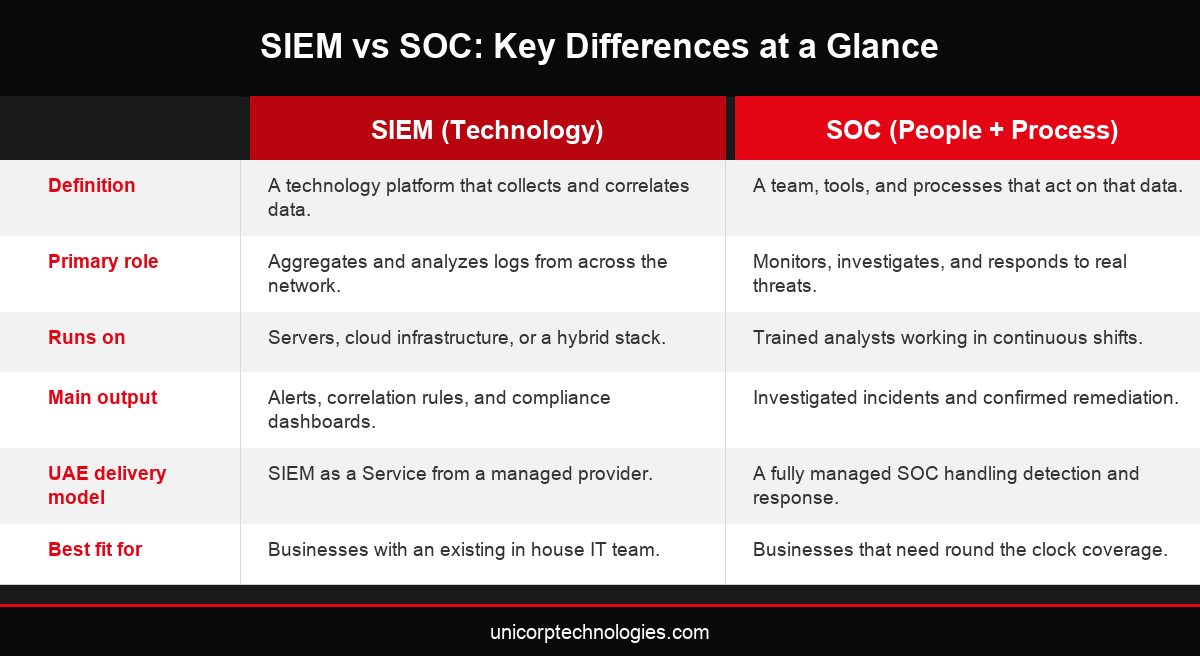
Some businesses only need SIEM as a service layered on top of an existing in house IT team. Others need a fully managed SOC because they lack the staff to monitor alerts around the clock. The comparison below breaks down how the two models differ across ownership, output, and best fit. A business with a mature in house IT team, a dedicated security lead, and defined escalation procedures may only need SIEM as a service, with Unicorp handling log correlation and alerting while its own staff drives incident response. This suits organizations with limited headcount growth plans but strong existing processes. A business without dedicated security staff, or one that needs verified round the clock coverage for compliance reasons, typically needs a fully managed SOC. This is the more common model among UAE enterprises, since building a 24/7 analyst rotation in house is expensive and hard to staff locally. The comparison below shows how SIEM and a SOC differ across definition, primary role, output, and typical UAE delivery model.
How UAE Enterprises Typically Adopt These Services
Most mid size and large UAE organizations do not build a SOC from scratch. They subscribe to SIEM as a service, a fully managed SOC, or a hybrid model where internal staff handle first line triage and an external partner escalates complex incidents.
UAE regulatory pressure is accelerating this shift. The UAE national cybersecurity strategy has pushed compliance from voluntary guidance toward mandatory resilience for critical sectors including banking, healthcare, and government, and continuous monitoring is now an explicit expectation rather than a nice to have. For organizations already searching for managed service providers near me, folding SOC services into that existing relationship is usually more practical than running a separate vendor for detection and response. A cyber security consultant can assess current SIEM maturity, identify coverage gaps, and recommend whether SIEM as a service, a managed SOC, or a hybrid model fits the organization's risk profile and budget. Unicorp's infrastructure and cloud security engagements often start exactly this way, with an assessment before any technology or staffing commitment. A hybrid model is common among larger enterprises too. Internal staff handle routine first line triage during business hours, while an external SOC provider owns overnight and weekend coverage, escalating anything that looks like a confirmed incident back to the internal team for final sign off. Choosing Between SIEM, a SOC, or Both
The right decision depends on three factors: existing IT maturity, compliance requirements, and how quickly the business needs to detect and respond to threats. Most growing UAE enterprises eventually need both technology and a team, delivered as one managed service.
Start by mapping what already exists. If log collection and correlation are missing entirely, SIEM as a service closes that gap first. If logs exist but nobody reviews alerts outside business hours, a managed SOC closes the more urgent gap, since unmonitored hours are consistently the entry point attackers use. Network security solutions work best when the technology and the team are procured together, because a SIEM platform tuned by the same analysts who respond to its alerts produces fewer false positives over time. Unicorp designs soc services this way, pairing SIEM technology with a dedicated analyst team so clients are not left managing two disconnected vendors. Businesses evaluating a buy soc services provider near me shortlist should ask for evidence of both layers working in tandem, not just a demo of the dashboard. An independent cyber security consultant can help draft this shortlist and score each provider against the same criteria, so the comparison stays objective rather than driven by whichever vendor presents the slickest sales deck.
Conclusion
SIEM and a SOC solve different problems. SIEM collects and correlates data. A SOC investigates and responds to what that data reveals. Most UAE enterprises need both working together, delivered as coordinated soc services rather than two separate purchases. If your organization is unsure whether it needs SIEM as a service, a fully managed SOC, or a hybrid model, talk to Unicorp's cyber security team for an assessment based on your current infrastructure and compliance obligations. The right combination closes detection gaps before they become costly incidents.
Frequently Asked Questions
What is the difference between SIEM and a SOC?

Do small businesses need soc services or just a SIEM tool?
Can a business run SIEM without a SOC?
How much does a managed SOC cost compared to an in house team?
What compliance frameworks require SOC style monitoring in the UAE?
Is SIEM as a service the same as a managed SOC?
How fast should a SOC detect a threat?
Can Unicorp manage both SIEM and SOC services together?
How do I know if my business needs a managed SOC provider near me?