Vulnerability Assessment Services in Abu Dhabi: NESA Guide

Government entities in Abu Dhabi are assessed against information assurance expectations broader than any technical test, and vulnerability assessment services bought without that framing fall short. A report listing exploitable weaknesses satisfies engineers and answers perhaps a third of what an assurance reviewer asks. The rest concerns scope completeness, testing frequency, remediation governance and the evidence linking them. This article sets out how to confirm which standard applies, then scope, run and evidence assessments so the output serves both purposes. Our note on why a proactive security strategy beats reactive patching covers the underlying discipline.
Key Takeaways
- Assurance reviewers examine the programme, not the report. Scope completeness, cadence, remediation governance and evidence continuity carry as much weight as the findings themselves.
- Scope from the asset register and then challenge the register, because the gap between documented and reachable assets is where most government findings originate.
- Design the evidence pack at procurement, so that every engagement produces assurance-ready artefacts rather than a technical report someone must translate afterwards.
Which Standard Applies in Abu Dhabi
Start by naming the standard, because a buyer in Abu Dhabi may answer to more than one. Federal entities and critical sectors commonly refer to the UAE Information Assurance standards, still widely known by the NESA name. Some vendors now describe the issuing body as the Signals Intelligence Agency, so ask your compliance lead which wording and version your reviewer uses.
National policy is also moving. The UAE Cyber Security Council has released Cabinet-approved national cybersecurity policies, and its National Cloud Security Policy Version 2.0 reaches federal bodies and Emirate entities. Confirm how these sit alongside your existing assurance obligations before the statement of work is written.
Sector rules can add another layer. Healthcare entities licensed by the Department of Health work with the Abu Dhabi Healthcare Information and Cyber Security Standard, known as ADHICS. Abu Dhabi government digital policy now sits with the Department of Government Enablement, which succeeded the Abu Dhabi Digital Authority, so check any older references in your procurement templates.
Vulnerability assessment services should reflect that map from the first scoping call. The same programme can often serve a wider audience. Testing cadence, website penetration testing and retest evidence apply equally to enterprise cybersecurity services bought by semi-government and private firms across Abu Dhabi and Dubai. What changes is the standard you map the results against, and the evidence a reviewer expects to see. Entities in Dubai, for example, may need to map the same vulnerability assessment services to the Dubai Electronic Security Center's regulation instead.
What Reviewers Expect From Vulnerability Assessment Services
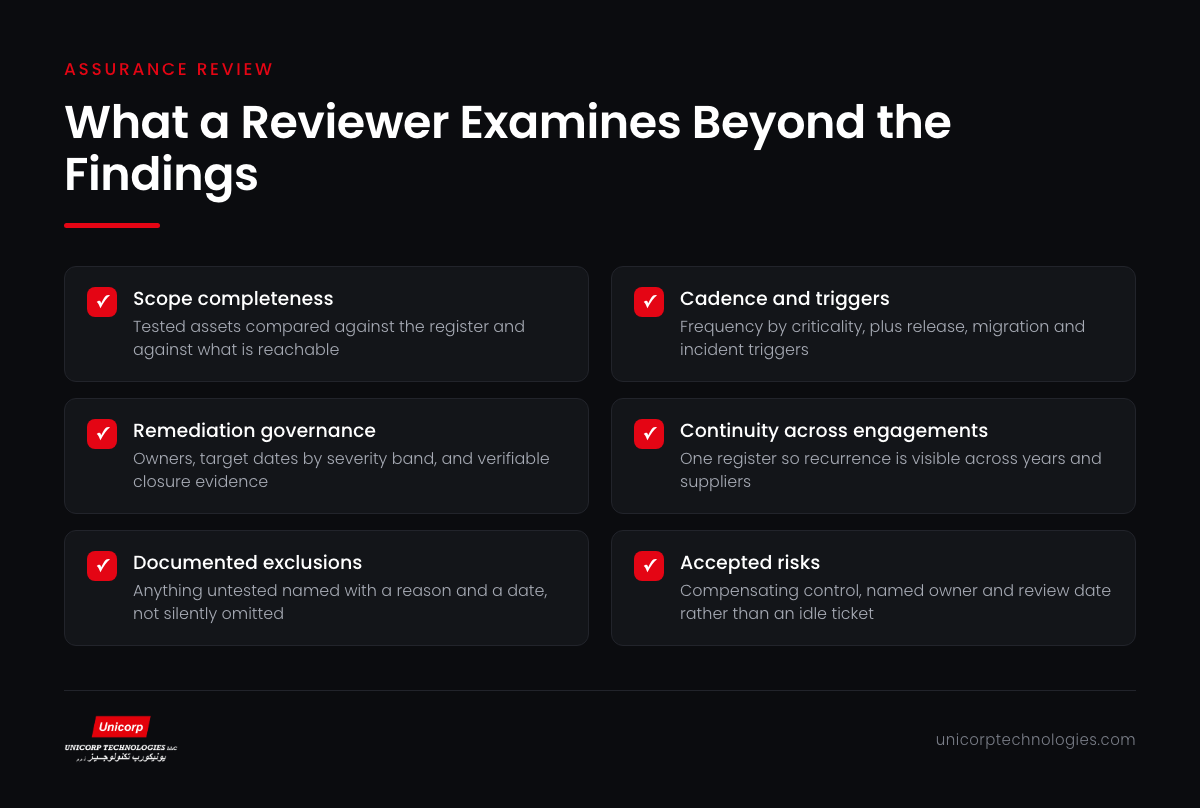
When an assurance reviewer examines vulnerability assessment services, the first question is whether scope covers the whole estate. Reviewers compare the tested asset list against the entity's own register and against what is reachable from outside, and a scope that omits a category, whether operational technology, a partner-facing portal or an acquired system, undermines the entire submission regardless of how thorough the tested portion was.
The second is cadence and trigger. Annual testing meets the minimum expectation and says nothing about the eleven months between. Reviewers look for a defined frequency by asset criticality, plus triggers that force an unscheduled assessment: a major release, a migration, an acquisition or a significant incident.
The third is remediation governance. Findings need owners, target dates by severity, and evidence of closure that a reviewer can verify. An entity with a large open backlog and a clear, funded plan generally scores better than one with a small backlog and no visible process, because the process is what the reviewer is assessing.
The fourth is continuity across engagements. Where each assessment is commissioned independently, findings cannot be tracked across reports and recurrence is invisible. A programme that shows the same finding closed, reopened and closed again is telling a reviewer something important, and only a continuous register makes that visible.
Control catalogues written for restricted environments, such as NIST SP 800-171, are a useful structural reference when mapping assessment activity to assurance requirements.
Scoping Vulnerability Assessment Services Against the Real Estate
Start from the asset register and then treat it as a hypothesis. In government estates, the reachable estate often differs from the documented one, usually because a project provisioned something outside the standard process or because a decommissioned system was never actually switched off.
Run an external discovery pass before agreeing scope. Enumerating what actually answers on the entity's public address space, domains and cloud tenancies routinely surfaces assets nobody expected, and each one found during scoping is one not found in a review.
Include the categories that are usually excluded. Operational technology in facilities, building management systems, partner-facing portals, and systems inherited through mergers of entities all carry real exposure and all tend to fall outside a default scope written around the corporate network.
Government estates in Abu Dhabi also need the testing window agreed against the entity's own service calendar rather than the provider's availability. Government estates carry seasonal load patterns around registration deadlines, examination periods and public service peaks, and an assessment scheduled into one of those windows is either postponed at short notice or run with so many carve-outs that the coverage evidence becomes weak.
Where a category genuinely cannot be tested in the current cycle, record that explicitly with a reason and a date rather than leaving it silently out of scope. A documented exclusion is a manageable finding; an undocumented one reads as an oversight.
Testing Types and When Each Applies
Vulnerability assessment and penetration testing are often bought together, but each type answers a different question. Authenticated infrastructure assessment covers configuration weaknesses, missing patches and insecure services across servers and endpoints. It should run on a defined cadence and is the backbone of the programme, because it produces the coverage evidence reviewers look for first.
Application testing, including dynamic testing against running systems, is required for anything citizen-facing or handling personal data. Authorisation flaws in particular do not surface without a tester holding two accounts at different privilege levels, and provisioning those accounts before the window opens is a scoping detail that decides whether the category is covered at all.
Published hardening benchmarks such as the CIS Critical Security Controls give a defensible baseline to review against, which matters because a reviewer will ask which standard the configuration was compared to rather than simply whether it was reviewed. Configuration review against a hardening baseline complements both and is frequently the fastest route to reducing exposure, since it finds the systematic deviations that individual host testing reports one at a time.
Adversarial simulation has a place once detection capability exists, but for most government entities it should follow rather than replace the coverage-focused work. Comprehensive vulnerability assessment services delivered on a reliable cadence produce more assurance value per dirham than an occasional red team against an estate whose baseline coverage is incomplete.
Our note on how hidden weaknesses surface during testing covers what each type finds in practice.
The Evidence Pack
Design the evidence pack at procurement rather than assembling it afterwards. Six artefacts cover most assurance requirements, and specifying them in the statement of work costs nothing while saving weeks later.
First, a scope document naming what was tested, what was excluded and why. Second, the methodology and the standards it aligns to. Third, the findings register with severity, the full scoring vector, the affected asset identifier and reproduction detail. Fourth, the remediation plan with owners and target dates by severity band.
Fifth, retest evidence confirming closure, which is the artefact most often missing and the one reviewers ask for most consistently. Sixth, a continuity view showing findings across engagements so that recurrence is visible rather than hidden by report boundaries.
Require the asset identifier on every finding so that reports from different suppliers, or from different years, can be joined. Without a shared identifier the continuity view is impossible to build, and each assessment becomes an isolated snapshot.
Ask for the full scoring vector rather than the headline severity, so that your own team can re-derive ratings, adjust environmental metrics for your context, and compare consistently across engagements from different providers.
Remediation That Survives the Review
Fund remediation alongside assessment, and rank the work before assigning it. Our guide to ranking findings by business impact shows how. Entities that procure testing without a corresponding remediation budget accumulate findings they cannot close, and the register itself then becomes the evidence of a programme that is not working. A reviewer reads a growing backlog as an assurance failure regardless of how good the testing behind it was.
Set target closure times by severity band and publish them, because a reviewer will ask what your standard is before asking whether you met it. Bands stated and mostly met read considerably better than no bands at all.
Prioritise by exposure and evidence of real exploitation rather than by severity alone. A finding on an internet-facing service that appears in public catalogues of actively exploited vulnerabilities outranks a higher-rated finding behind several authentication layers, and reviewers accept that reasoning when it is documented.
Group findings by the process that produced them before assigning. Twelve instances of an expired certificate are one lifecycle failure, and closing the process rather than the instances is both cheaper and far more persuasive as evidence of maturity.
Report closure with evidence rather than assertion. A ticket marked resolved is not closure; a retest confirming the finding no longer reproduces is. Where retesting is not included in the engagement, the entity carries the burden of proving closure itself, and in practice that proof is rarely produced, which is why so many registers show large numbers of items closed on trust.
Record accepted risks properly. An honest entry with a compensating control, a named owner and a review date stands up to scrutiny; an open item with no movement across three reports does not. Entities are rarely penalised for accepting a risk deliberately and frequently penalised for leaving one undecided.
Our note on remote access controls under modern UAE mandates covers a control area that recurs in government assessments.
Procuring the Programme
Buy vulnerability assessment services as a programme rather than as a report, whether your teams sit in Abu Dhabi, Dubai or both. A multi-engagement arrangement with a defined cadence, a continuous findings register and included retesting produces the continuity evidence that single engagements cannot, and it usually costs less than commissioning the same work piecemeal.
Specify the evidence pack in the statement of work, along with the requirement that findings carry asset identifiers and full scoring vectors. Providers can deliver this easily when asked and rarely volunteer it.
If you are comparing vapt services UAE providers offer, check that each one can work with the categories your estate actually contains, particularly operational technology and legacy systems, and confirm who will be doing the work rather than who is presenting the proposal.
Ask how findings will be delivered between engagements, because a programme that reports only at the end of each cycle leaves the entity blind for months.
Confirm clearance, residency and confidentiality arrangements early, particularly for Abu Dhabi government work, since these frequently constrain the supplier list more than technical capability does for government entities.
If you are designing an assessment programme or preparing for a review, our Abu Dhabi team can help scope it against these expectations. You can also see how Unicorp's VAPT and risk assessment team supports assessment, remediation and assurance evidence.
Frequently Asked Questions
What should vulnerability assessment services give an assurance reviewer?

Is annual testing sufficient?
Why challenge the asset register during scoping?
Which asset categories are usually missed?
What if a category cannot be tested this cycle?
What belongs in the evidence pack?
Why do findings need asset identifiers?
Should red teaming replace regular assessment?
How should accepted risks be recorded?