When Should You Deploy a Resident Cybersecurity Engineer?

Searching for a cyber security expert near me and hiring one to sit inside your building are different decisions, and the second is often taken for the wrong reason. Resident engineering is expensive, scarce and highly effective in specific conditions, and considerably less effective than a remote managed service in others. The question is not whether an embedded engineer adds value, because they almost always do. It is whether the value they add is the value your estate currently needs most. This article sets out the five conditions that genuinely justify a resident placement, the three that look convincing and are better solved another way, and how to scope the engagement so the placement produces capability rather than dependency. Our note on the three entry points attackers exploit most in the UAE covers the risks that usually prompt the conversation.
Key Takeaways
- A resident engineer is justified by physical, contextual or clearance constraints that a remote team genuinely cannot work around, not by response time alone.
- Scope the placement around a defined capability outcome with a handover date, or it becomes a permanent staffing arrangement that hides the gap it was meant to close.
- Measure the engagement on what the internal team can do afterwards, not on tickets closed, or you will renew a dependency rather than build a function.
What a Resident Engineer Actually Provides
A resident engineer is a specialist who works from your premises, inside your teams, on your estate, for a defined period. The value is not simply proximity. It is context: knowing which application the finance team runs on the last Thursday of the month, which supplier has network access and why, and which legacy system everyone quietly works around. That knowledge cannot be transferred in a handover document because nobody writes it down.
The second thing they provide is presence in conversations that never reach a ticket. Architecture decisions, vendor selections and project scoping all happen in rooms a remote service is not in, and security input at that stage costs a fraction of what it costs after deployment. Enterprises consistently report this as the largest return, and it is the hardest to quantify in advance.
Third is physical access. Control catalogues written for restricted environments, such as NIST SP 800-171, assume a level of hands-on assurance that remote coverage cannot deliver on its own. Operational technology, air-gapped environments, hardware security modules and secure facilities all require someone on site, and no amount of remote tooling changes that. Where an estate has significant physical or isolated components, remote-only coverage has a permanent blind spot.
What a resident engineer does not provide is coverage. One person works one shift, takes leave and eventually resigns. Organisations that place a resident engineer expecting continuous monitoring have bought the wrong thing, and usually discover it during the first out-of-hours incident.
Understanding this split, deep context and physical presence on one side, continuous coverage on the other, is what makes the decision straightforward. The two models solve different problems and the strongest programmes use both.
Five Conditions That Justify the Placement
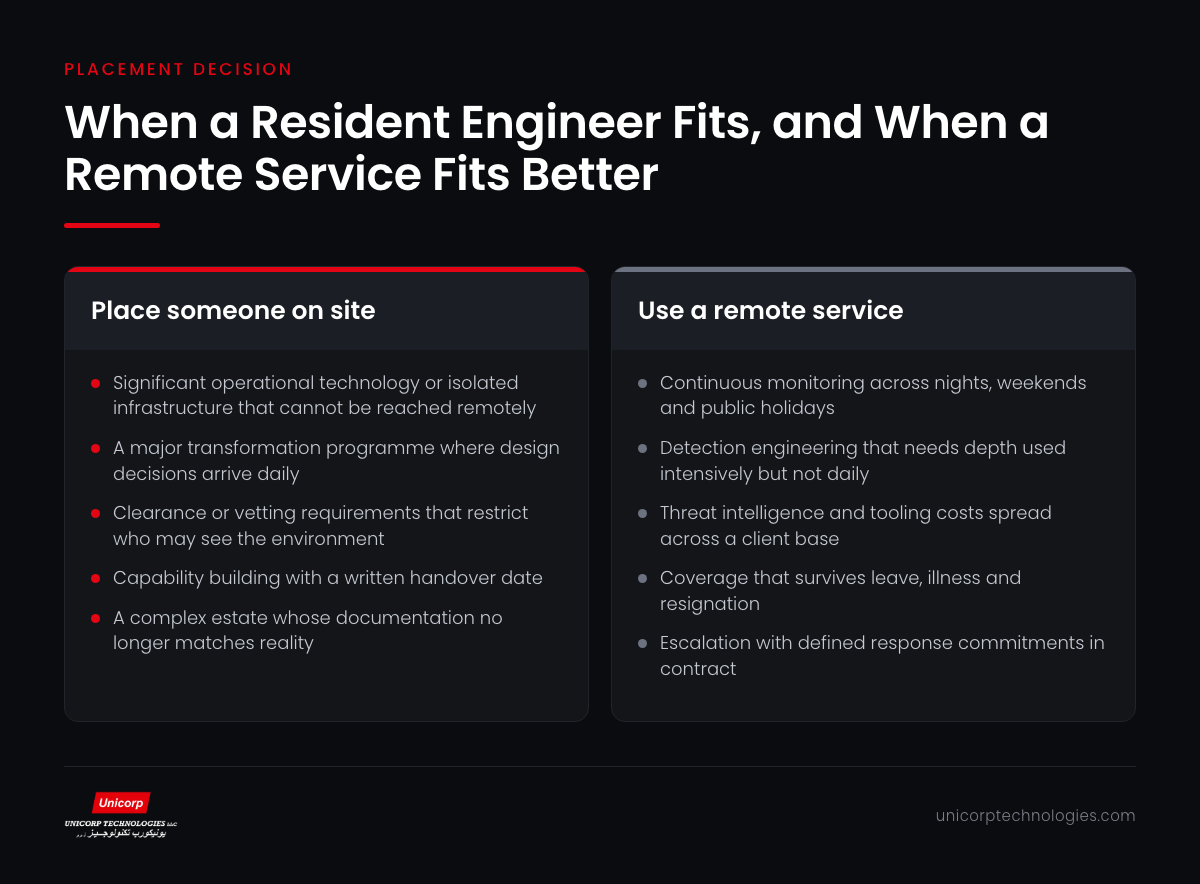
The first is significant operational technology or isolated infrastructure. Manufacturing lines, utilities, healthcare equipment and secure government facilities all contain systems that cannot be reached remotely and cannot be patched on a normal cycle. Someone has to be physically present to assess them, and that person needs to understand the process the equipment supports before recommending any change.
The second is a major transformation programme. During a cloud migration, a core system replacement or a merger integration, security decisions arrive daily and each one is cheaper to influence at design than to remediate afterwards. A resident engineer embedded in the programme team catches these; a remote service reviewing documentation after the fact does not.
The third is a regulatory or clearance requirement that restricts who may see the environment. Some UAE government and defence-adjacent work requires personnel to be vetted and on site, which removes the remote option regardless of preference.
The fourth is capability building with a defined end. Where an organisation is standing up its own security function, an experienced engineer working alongside the new team transfers judgement far faster than training courses do. This condition carries an important qualifier: it requires a handover date written into the engagement from the start.
The fifth is a complex estate with poor documentation. When nobody can produce a current architecture diagram and the people who built the environment have left, remote assessment produces a picture of what the documentation claims. Reconstructing reality takes someone walking the estate, and that work has a natural end point once the picture exists.
Three Reasons That Look Convincing and Are Not
The first is response time. Physical presence does not improve response to a security incident, because the response is technical and remote hands are almost never the constraint. What improves response time is monitoring coverage, defined runbooks and pre-authorised containment actions, all of which a well-run managed service provides more reliably than one person who is asleep at three in the morning.
The second is cost. Resident placement is rarely cheaper than a managed service for equivalent coverage, and comparisons that suggest otherwise usually compare one full-time engineer against a service including tooling, twenty-four hour staffing, threat intelligence and escalation. Those are not equivalent scopes and should not be priced as if they were.
The third is hiring difficulty. Placing a contracted engineer because the recruitment market is hard is an understandable short-term move and a poor structural answer, because it removes the pressure that would otherwise drive the hiring or outsourcing decision. Two years later the role is still unfilled and the contractor holds the knowledge.
None of these means a resident placement is wrong in those situations. It means the placement is solving a different problem than the one stated, and being honest about which problem you are solving produces a better scope. Many organisations searching for a cyber security expert near me are really describing a coverage gap, which is a managed service question rather than a placement one.
Scoping the Engagement Properly
Write the scope around an outcome rather than a role. Compare the two framings: provide security engineering support to the infrastructure team, against establish security review as a mandatory gate in the change process, with the internal team running it unaided within nine months. The first produces an open-ended arrangement; the second produces something you can finish.
Define the reporting line explicitly. A resident engineer who reports to the operations team they are meant to challenge will be absorbed into business as usual within a quarter. Reporting to the security function, or to the programme sponsor during a transformation, preserves the independence that makes the placement useful.
Set knowledge transfer as a deliverable, not an aspiration. Named internal counterparts, documented runbooks, recorded walkthroughs and a shadowing period before the engagement ends. Without these written into the contract, the placement ends and the capability leaves with the individual.
Align the placement to a recognised control framework so that the work produces auditable evidence rather than undocumented improvement; the NIST Cybersecurity Framework is the usual reference point for UAE enterprises. Agree escalation and out-of-hours arrangements at the outset. The resident engineer is not the incident response team and should not be expected to become one by default. Where they are the first point of contact, name the escalation path behind them and confirm the managed service or supplier commitments that sit behind it.
Finally, agree what happens to access when the engagement ends. Contractor accounts surviving the contract are among the most common findings in access reviews, and the offboarding step should be scheduled at the same time as the onboarding one. Our note on proven security outcomes and AI guidance in the UAE covers the governance context.
Measuring Whether It Worked
The wrong measure is activity: tickets handled, assessments completed, hours delivered. All of these can be high while the underlying capability gap stays exactly where it was, and they encourage renewal rather than completion.
The right measures are capability transfers. How many processes the internal team now runs without support that it could not run at the start. How many of the resident engineer's recurring tasks have been documented and handed over. Whether the security gate in the change process functions when the engineer is on leave, which is the honest test.
Add a second dimension for transformation placements: decisions influenced at design stage. Recording the security input given during architecture and vendor selection, and what changed as a result, captures the value that never appears in a ticket queue and is the main justification for the placement in the first place.
Review at the midpoint rather than at the end. If knowledge transfer has not started by then it will not finish, and the midpoint is where the engagement can still be redirected. Engagements reviewed only at renewal almost always renew.
A useful final question at each review: if this engineer left tomorrow, what would stop working. A shrinking answer means the placement is succeeding. A stable or growing answer means it has become a dependency.
Choosing Between the Models
Most enterprises do not face a binary choice. The strongest arrangement is usually a managed service providing continuous monitoring and incident response, with a resident engineer placed for a defined period against one of the five conditions above. The service provides coverage; the engineer provides context and physical reach.
When you evaluate providers, ask how the two connect. A resident engineer from one supplier and a monitoring service from another can work, but only if escalation paths, tooling access and reporting lines are agreed in writing. Where both come from the same partner, ask specifically how the engineer's local knowledge reaches the remote analysts, because that transfer is where the combined model earns its premium.
Ask also about continuity. What happens when the resident engineer takes leave or resigns, whether a named substitute exists, and how their knowledge is captured. A placement with no continuity plan reintroduces exactly the single point of failure it was meant to remove.
Organisations comparing it managed service providers should judge both models on the same criteria: coverage hours, escalation commitments, evidence of capability transfer, and what the arrangement looks like in twenty-four months. Anyone searching for a cyber security expert near me should start by writing down which of the five conditions applies, because that single answer determines the shape of everything else.
If you want help deciding which model fits your estate, our team can review your coverage and context gaps and set out the options. You can also see how our professional services practice structures resident and remote engagements, and our note on secure AI systems in regulated sectors.
Frequently Asked Questions
Does a resident engineer improve incident response times?

Is a resident placement cheaper than a managed service?
What conditions genuinely justify an on-site engineer?
How should the engagement be scoped?
Who should the resident engineer report to?
What measures show the placement is working?
Can a resident engineer replace a managed service?
What happens at the end of the engagement?
How do we keep the placement from becoming permanent?