Zero Trust Security Services in Dubai: ZIA, ZPA, ZDX

Zero trust security services are often sold as a single platform and bought as one line item, leaving Dubai enterprises unclear about what they have licensed. A Zscaler deployment, for example, contains three separate products that solve three separate problems. Organisations regularly deploy one, conclude the platform is limited, and never activate the module that addresses their real complaint. This guide explains Zscaler Internet Access (ZIA), Zscaler Private Access (ZPA) and Zscaler Digital Experience (ZDX) in plain terms, sets out a practical deployment order, and names the overlaps with tools you probably own. Our note on consolidating ZIA, ZPA and ZDX for BFSI covers the banking case.
Key Takeaways
- Internet access, private application access and digital experience monitoring are three separate problems. One module addresses each, and buying the suite does not mean any of them are configured.
- Deploy internet access first for immediate risk reduction, private access second to retire the VPN, and experience monitoring third to defend the change against user complaints.
- Each module overlaps something you already own. Decide what gets decommissioned at design time, or you will run both and pay twice.
ZIA: The Internet Access Module
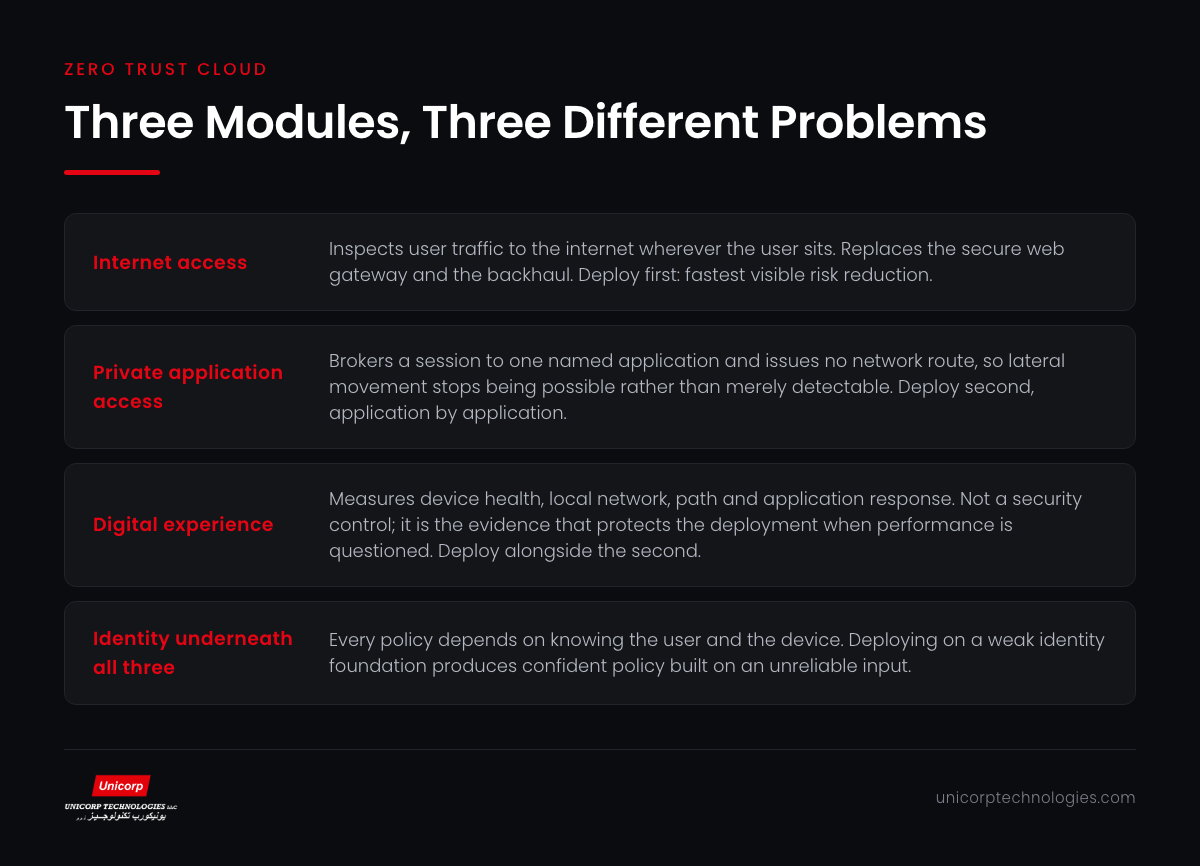
Zscaler describes ZIA as secure internet and SaaS access. It is the sase security component most teams meet first. In practice, the module inspects traffic between users and the internet, wherever those users are. It replaces the traditional secure web gateway and the backhaul that carried branch and remote traffic to a central inspection point, which is where most of the latency in a legacy design comes from.
Functionally it does five things: decrypts and inspects encrypted traffic, applies URL and category policy, sandboxes suspicious files, prevents sensitive data from leaving through web channels, and controls which cloud applications users may reach and what they may do inside them.
That last capability is the one most often left unconfigured and the most valuable. Distinguishing between a corporate instance of a productivity application and a personal one, and permitting upload to the first while blocking it to the second, addresses a real data exposure route that a URL policy cannot express.
The decryption decision is where deployment usually stalls. Inspection requires decrypting encrypted traffic, which means installing a certificate on every device and deciding what to exclude for privacy or regulatory reasons. Banking and health categories are commonly excluded, and the exclusion list should be a documented policy decision rather than an operational convenience.
Policy design deserves as much attention as the rollout. Category-based rules are easy to write and produce the largest volume of user friction, while the rules that actually reduce risk, distinguishing a corporate application tenant from a personal one and controlling what may be uploaded to each, take longer to build and are rarely completed. Enterprises that spend the first month on categories and never reach tenancy control have bought a web filter.
For Dubai enterprises the immediate return is straightforward: consistent policy for users in an office, at home or travelling, without the latency of backhaul. That alone justifies the module for most distributed organisations.
ZPA: The Private Application Access Module
ZPA handles access to internal applications, and it is the one that replaces the VPN. The mechanism is different in a way that matters: instead of placing a user on the network and relying on segmentation to limit them, it brokers a session to one named application and issues no network route at all.
That difference eliminates lateral movement as a capability rather than as a detection problem. A compromised endpoint with an active session reaches the applications that session was authorised for and nothing else, because there is no network to scan and no adjacent host to discover.
It also inverts the exposure model. Connectors deployed beside the application make outbound connections to the broker, so the application never listens on an inbound path from the internet. Internal applications stop appearing in external scans entirely, which removes a category of exposure rather than defending it.
Migration is application by application. Start with web-delivered applications that already have clean authentication, and each migration removes a group of users from the legacy remote access service. Thick-client and legacy applications need a plan, usually connector-based publishing or a delivered desktop session, rather than a permanent exception.
ZDX: The Digital Experience Module
ZDX is not a security control, and enterprises that evaluate it as one usually decline it and then regret the decision. It measures the experience of the user: device health, local network conditions, the path to the application, and the application's own response time, stitched into a single view.
Its value is political as much as technical. When a security architecture changes, every performance complaint is attributed to it, and without measurement the security team cannot demonstrate otherwise. This module produces the evidence that a slow session was caused by a home wifi problem or an application server, and that evidence is what protects the deployment from being rolled back.
It also shortens support cycles substantially. A helpdesk that can see the segment causing a problem stops escalating between network, application and security teams, and the mean time to resolve user-reported issues falls sharply.
Treat it as deployment insurance and budget it as part of the programme rather than as an optional extra. Enterprises that deploy the first two modules without it spend the following quarter defending the architecture with anecdotes.
Our note on how multi-cloud UAE enterprises approach platform security covers how this fits a wider platform strategy.
Overlaps With What You Already Own
Each module overlaps something in the existing estate, and deciding what gets decommissioned is a design activity rather than an afterthought. The internet access module overlaps the secure web gateway, parts of the firewall's web filtering, and potentially a separate cloud application control product.
The private access module overlaps the VPN concentrators and, in some designs, parts of the network access control deployment. Running both indefinitely is common and expensive, and the usual cause is that no decommissioning date was set at the outset.
Structured references such as the Cloud Controls Matrix help here, because they let you map which control each product satisfies rather than comparing feature lists that use different vocabulary for the same capability.
Data protection capabilities overlap existing data loss prevention tooling. The platform inspects web and cloud application channels; the existing tool typically covers endpoint and mail. Rationalising policy across both, rather than maintaining two independent rule sets, avoids the situation where a file blocked on one channel leaves freely through another.
Write the decommissioning plan into the deployment plan with dates. Every month both stacks run is a month of double licensing and a month in which policy can diverge between them, which is a security problem as well as a financial one.
The architectural reference for all of this is NIST SP 800-207, which describes the decision points these modules implement and is worth mapping the deployment against.
Zero Trust Security Services in Dubai: Local Questions
Requests for zero trust remote access Dubai teams can adopt usually begin with a VPN problem, so ZPA gets the first conversation. Secure remote access solutions are only one part of the decision, though. Three local questions shape how zero trust security services are designed here.
First, confirm which rules apply, particularly if your group also has an entity in Abu Dhabi or ADGM. Dubai Government Entities work under the Dubai Electronic Security Center's Information Security Regulation, a technology neutral framework, and cloud providers serving them face a separate DESC standard. Firms in the DIFC have their own data protection law. Ask each vendor where inspection, logs and policy data are processed, and take that answer to your compliance lead.
Second, define what decryption may touch. Banking and health traffic are common exclusions, and a list agreed with legal and HR is easier to defend than one built by the network team alone.
Third, plan alongside your existing network security solutions. Most Dubai estates will run firewalls, branch links and the new platform side by side for some time, so name the owner of each policy during that period.
Our note on a practical first phase for UAE enterprises covers starting points for firms earlier in the journey.
Deployment Order and Identity First
Before any zero trust security services go live, identity has to be sound. Every policy these platforms enforce depends on knowing who the user is and what device they are on, and deploying zero trust security services on top of a weak identity foundation produces confident-looking policy built on an unreliable input.
Then deploy ZIA first. It delivers visible risk reduction quickly, it does not depend on the private access work, and it gives the organisation experience with the platform on lower-stakes traffic before internal applications depend on it.
Deploy ZPA second, application by application, with ZDX running from the start of that phase so that performance questions can be answered with data. Retire the VPN as the population moves rather than at the end, so the saving arrives progressively.
Zero trust security services need an exception process before the first migration, not after the first escalation. Some applications will not work through a broker on the first attempt, and without a defined route to record a temporary exception with an owner and a date, the pragmatic answer becomes leaving the legacy path open indefinitely for that team. That is how a VPN survives three years past its retirement date.
Expect the whole programme to take longer than the vendor timeline suggests, largely because of the applications nobody has documented and the exceptions nobody has decided. Building the application inventory is usually the critical path, and starting it early is the single most useful thing an enterprise can do.
If you are evaluating or midway through a deployment, our Dubai team can review the module design and sequencing with you. You can also see the access and attack surface controls Unicorp deploys, and our note on proven security outcomes across UAE estates.
Measuring the Programme
Track four things. The proportion of internet traffic inspected, which shows whether coverage is real or partial. The number of applications migrated to brokered access against the total, which shows progress toward VPN retirement. The remaining legacy remote access population. And the count of policy exceptions with owners and expiry dates.
Add user experience alongside them, taken from ZDX rather than from a survey. A programme that improves security and degrades experience will be reversed eventually, and having the measurement in hand lets problems be fixed rather than argued about.
Report exception counts prominently. Exceptions are where zero trust programmes quietly fail, and a number that grows month on month indicates that the design does not fit some part of the estate and that the gap is being managed by carve-out rather than by architecture.
Review the policy set quarterly for contradictions. Policy sets grow, and once they pass a few dozen rules the interactions become difficult to reason about, which produces access failures that are investigated as platform faults rather than as policy errors.
Effective zero trust security services are a programme with a decommissioning plan, an application inventory and an exception register, not a licence with three modules enabled. That holds for firms in Dubai and Abu Dhabi alike, and for any buyer comparing zero trust security services across both emirates.
Frequently Asked Questions
What do zero trust security services like ZIA actually do?

How is private application access different from a VPN?
Is the digital experience module a security control?
Which module should be deployed first?
Why does decryption stall deployments?
What do these modules overlap?
How do internal applications stop appearing in external scans?
What usually sits on the critical path?
What should we measure?